
May 20, 2026
A Successful E-Bus Transition Requires Private Sector Investment and Collaboration
Around the world, cities are grappling with how to decarbonize the urban transport sector while expanding access to opportunity. Electric buses deliver on both.
Electrifying public buses cuts urban emissions and pollution while connecting people to jobs, education, and services. Yet despite this potential, the upfront cost and capacity needed to transition to an e-bus system have slowed progress. Development financing for sustainable urban transport, and bus electrification in particular, accounts for a small share of overall financing needs. Private financing could fill budget shortfalls, but public transport projects have not traditionally generated the revenues or short-term returns required for commercial investment.
Instead, electrification of private vehicles — cars and two-wheelers — has been a much larger focus of international climate financing in recent years. In fact, less than 10% of such financing has gone toward other essential decarbonization strategies such as buses, non-motorized transport, or transit-oriented development. While electric cars and chargers are important for reducing transport emissions, shifting investment toward high-volume, electric public transport is equally urgent. It offers broader benefits for air quality, inclusion, and urban livability, and is massively cheaper to implement and maintain.
Watch this ITDP webinar on the principles of zero-emission, high-quality public transport.
The Opportunity of E-Buses
Transitioning to comprehensive, integrated urban e-bus systems is not simply about replacing diesel buses with electric ones. Successful e-bus systems combine vehicle electrification with more efficient planning, regulation, and service integration. For example, e-buses create opportunities to improve informal transport. Because e-buses have been shown to attract private investment, governments have greater incentives to pursue contract and business-model reforms that enable such investment. This, in turn, can yield a more stable business environment and a more connected system that attracts more riders, satisfying operators.
E-buses offer multiple advantages over conventional diesel fleets. First, e-buses are quieter, cleaner, and more energy efficient, reducing air and noise pollution, particularly around depots and major corridors. E-buses are also typically equipped with modern amenities like air conditioning, accessible boarding, digital fare collection, and GPS, improving comfort, access, security, and reliability for bus riders. Anecdotally and supported by initial studies, e-buses can also expand bus ridership.
On-board technologies such as digital fare collection and GPS enable better bus operations and management, reducing operational costs and improving service delivery and efficiency. Finally, e-buses can also help to strengthen national economies. Public transport electrification can significantly reduce fuel imports and foreign-currency outflows, thereby increasing economic stability and growth, another incentive for governments to invest in this.
Read why scaling funding for electric public transport is key to ITDP’s strategic vision.
Unlocking Private Financing
Despite their benefits, e-bus systems face well-known financing barriers. Upfront costs for buses, depots, and charging infrastructure are high, and governments — especially those with limited fiscal capacity — often struggle to fund or finance these investments. Compared to traditional road projects, business models for e-bus systems are newer and less familiar to both public officials and private investors. As a result, projects can face long negotiation periods, high transaction costs, and greater perceived risk.
However, governments do not have to shoulder the financial burden of transitioning to an e-bus system alone. Investors, operators, and other private-sector players are increasingly interested in e-buses. The electrification transition is reshaping traditional public transport business models, making projects more attractive to a wider pool of investors, including leasing companies, utilities, private equity funds, and fintech firms. These new investors bring technical expertise, innovation, and financing flexibility.
We can see this in leasing models that allow governments or operators to pay for e-buses over time, as in Bogotá, Colombia, and utility co-investments in charging infrastructure, as seen in Santiago, Chile, and Addis Ababa, Ethiopia. Development finance institutions (DFIs), such as multilateral and national development banks, play a vital role in scaling e-buses by crowding in private investment through mechanisms like guarantees. Many DFIs have supported e-bus pilot projects, like those in Bogotá, São Paulo, Brazil, and Dakar, Senegal. The next step is to scale these projects and replicate successful models in many more cities.
Watch this 2025 Sustainable Transport Award keynote to learn more about the financing of Dakar’s electric BRT.
Bridging the Sectors
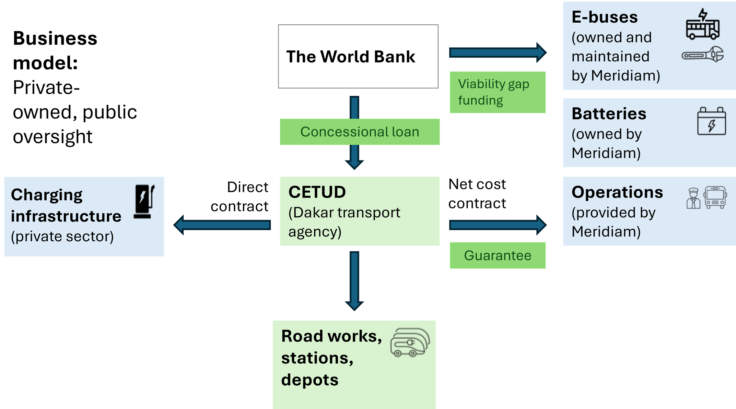
The electric BRT system in Dakar, Senegal, is an important case study in designing a public-private partnership for e-bus deployment that successfully distributes costs and risks. In Dakar, Meridiam, a private infrastructure investor, purchased 121 e-buses and operated them under a net cost contract with the Dakar transport agency, CETUD. Charging infrastructure was provided via a separate contract with another private company. The government provided the road works, BRT stations, and depots. Three key financing mechanisms were used to manage risk and were crucial for private sector involvement in the project:
- Concessional loan: The Senegalese government received a concessional loan from the World Bank IDA to provide lanes, stations, and depots – system elements that typically do not generate revenue and are not attractive for private investment.
- Guarantee: The net cost contract with Meridiam includes a minimum ridership guarantee, ensuring that Meridiam, as the system operator, will receive payment even if ridership drops below anticipated levels. In this case, the government will provide a subsidy to cover the difference between fare revenue and the minimum ridership level.
- Viability gap funding: The World Bank International Development Association (IDA) provided funding to cover the price difference between diesel buses and e-buses.
This innovative financing model, which enabled the implementation of Africa’s first all-electric BRT, won Dakar the Sustainable Transport Award in 2025. Now, other major African cities like Nairobi, Kenya, are looking to adapt the Dakar model to finance their own e-bus systems.
Investing In A Cleaner Future for All
Innovative financing models, reforms to existing business models and contracts, and catalytic investments from development banks are all crucial to scaling e-bus systems in the near term. This requires robust planning and project preparation, including realistic cost assessments, on the part of cities and national governments. It also requires transparent data from industry, governments, and development banks to widen the pool of investors who consider e-bus systems a viable investment.
Integrated, well-financed e-bus systems are essential for urban decarbonization and mobility improvements. When designed as comprehensive systems supported by clear financing frameworks and partnerships among governments, investors, and DFIs, e-buses can transform urban transport. Achieving this will require stakeholders and policymakers to take more collaborative steps to secure buy-in from both the public and private sectors.
We need to clarify investment pathways, strengthen coordination, and align incentives to truly accelerate the shift to better and more affordable public transport in all cities.