
May 29, 2026
ITDP’s Response to the Iran Energy Crisis
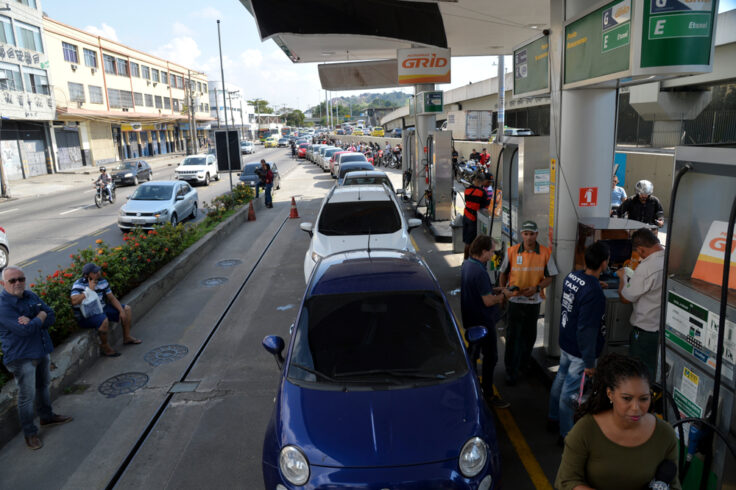
The current energy crisis, stemming from the closing of the Strait of Hormuz, has increased oil prices by up to 60% and natural gas prices by up to 100% in the last few months.
The transport sector is heavily reliant on these fossil fuels, and the global nature of oil markets has meant that even energy-exporting countries are not immune to the impacts of the crisis. The crisis has also established that the Strait is a critical vulnerability to international oil and natural gas flows. Even after the Strait is reopened, it could easily be closed again, sending prices soaring. This additional risk will likely be reflected in structurally higher costs for oil and natural gas. The current energy crisis is possibly one of the most damaging since the 1970s, with damage to critical energy infrastructure that may take years to rebuild, and confidence in the free exchange of fuel that may never return.
As a result of this crisis, the world is at a critical decision point, and the choices made now will impact future generations. So far, countries have reacted in two ways: 1 – subsidize existing energy use patterns to minimize the impacts on their populations, or 2 – use oil-derived energy more efficiently while ramping up efforts to electrify the transport sector. At ITDP, we strongly encourage countries to follow the second path, as it is in their best long-term economic interest.
Learn more about ITDP’s vision for fully electric, zero-emission transport systems.
Adding Fossil Fuel Subsidies Now is a Catastrophic Mistake
It is difficult to overstate how misguided adding fossil fuel subsidies is. The New York University Center on International Cooperation calls them “wasteful, polluting, and unfair”. At the same time, the Brookings Institution says that these subsidies “double down on commodities with an uncertain economic future”. Nearly everywhere, while they may aid the poor, energy subsidies are regressive, vastly favoring the car-owning and energy-consuming parts of the population that are least in need.
At their core, subsidies encourage people to use more fossil fuels, the precise wrong signal needed in a time of scarcity. Once in place, fuel subsidies are notoriously hard to remove, requiring carefully crafted policies to avoid harming the poor and precise timing during rare moments of opportunity. By artificially lowering fuel costs, subsidies increase consumption, delay a shift to more energy-efficient modes and cleaner fuels, worsen economic vulnerabilities, and delay efforts to address them.
A Better Approach: Efficiency and Electrification
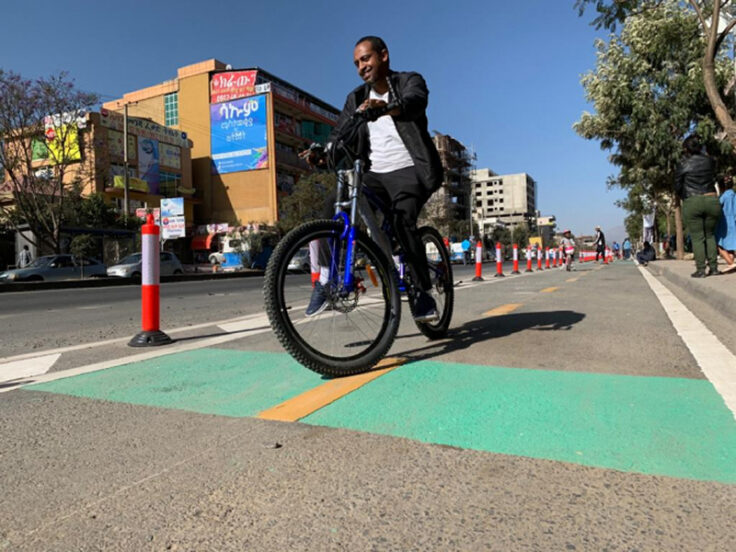
The economies of many countries are already vulnerable to shifting oil and gasoline prices, which can quickly drain foreign currency reserves, making it difficult to borrow money on international markets or import basic goods. This vulnerability has already led to dramatic action, even before the current energy crisis. Indeed, Ethiopia banned the import of ICE vehicles in 2024 and has rapidly invested in walking, cycling, and public transport. The ICE ban will take time to achieve results, but people are already using the improved bus services and cycling paths, saving money and fuel while maintaining access.
Similarly, after implementing fuel subsidies in the 1970s, Indonesia dramatically reduced them in 2015, cutting subsidy expenditures from 20% of the budget in 2014 to just 5% in 2015. In addition, the national government created the “Buy the Service” scheme to subsidize public transport, often for the first time, and to improve services to meet a minimum standard, alongside continued investments in bus rapid transit, metro, and light rail. These were further coupled with tax incentives for buying electric vehicles.
Learn more about Compact Cities – Electrified in this video.
In both examples, the changes from investing in modal shift have happened rapidly, as street space can usually be reallocated via temporary materials, as was done on a widespread basis during the 2020 COVID pandemic. Similarly, improved public transport services can be implemented relatively quickly. In the medium term, a shift to electric vehicles and especially electric buses, will require more investment. However, if governments begin signaling their interest in investment to bus and other vehicle manufacturers and build the right infrastructure (e.g., charging) needed to support the transition, the transition can readily take off in the coming years.
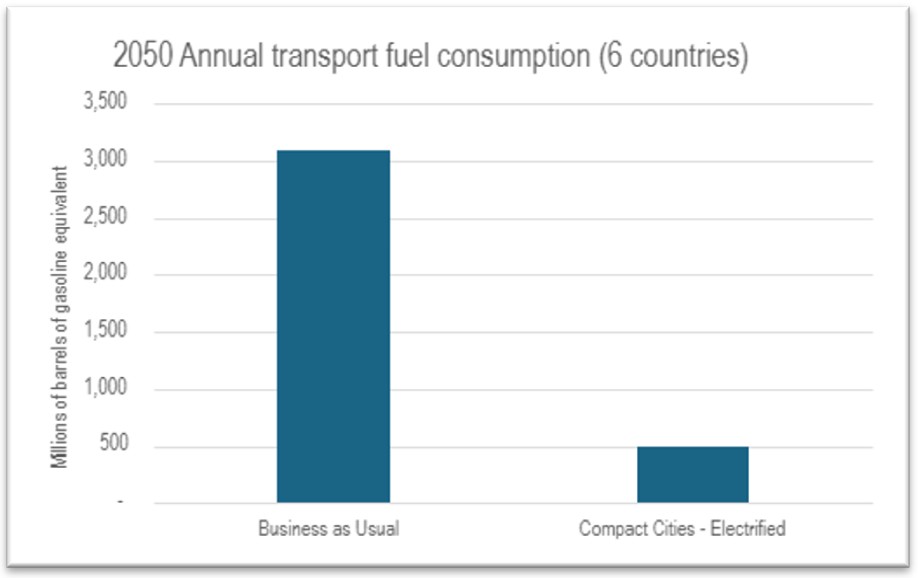
And unlike big fuel subsidies, which put additional strain on government budgets, an efficiency and electrification approach (which ITDP calls Compact Cities – Electrified) will actually save money in the long term, by building more efficient infrastructure (buses and trains require less pavement per person than cars), and using energy more efficiently (electric engines transfer ~75% of energy into motion, compared to 20% for ICE engines). This leaves more money to spend on other government priorities (e.g., education or health care). In addition, a Compact Cities – Electrified approach can dramatically reduce reliance on fuel imports, reducing vulnerability to future energy crises.
In many oil-exporting countries, such as Brazil and Mexico, oil revenues have risen significantly due to constrained supply in the Middle East. Instead of directing that money to fuel subsidies, it could be directed to support bus electrification and, later, the electrification of other vehicles. This is not the first energy crisis, and it will not be the last. In the 1970s, the Netherlands and the United States made vastly different energy decisions. In 2025, despite similar levels of wealth per capita, the average person in the United States used roughly three times as much gasoline and diesel as a person in the Netherlands. With lower baseline fuel consumption and a robust network of transportation options, people in the Netherlands are now much better able to cope with rising fuel prices than those in the United States. In the 1970s, cars and motorcycles were still rare in many countries, and they were not faced with the urgent choice of how to proceed.
In the current energy crisis, these countries are much wealthier and face a more pressing choice. Will they follow the path of United States, locking in oil dependency for generations to come, or will they follow the lead of the Netherlands towards a more resilient transport system?