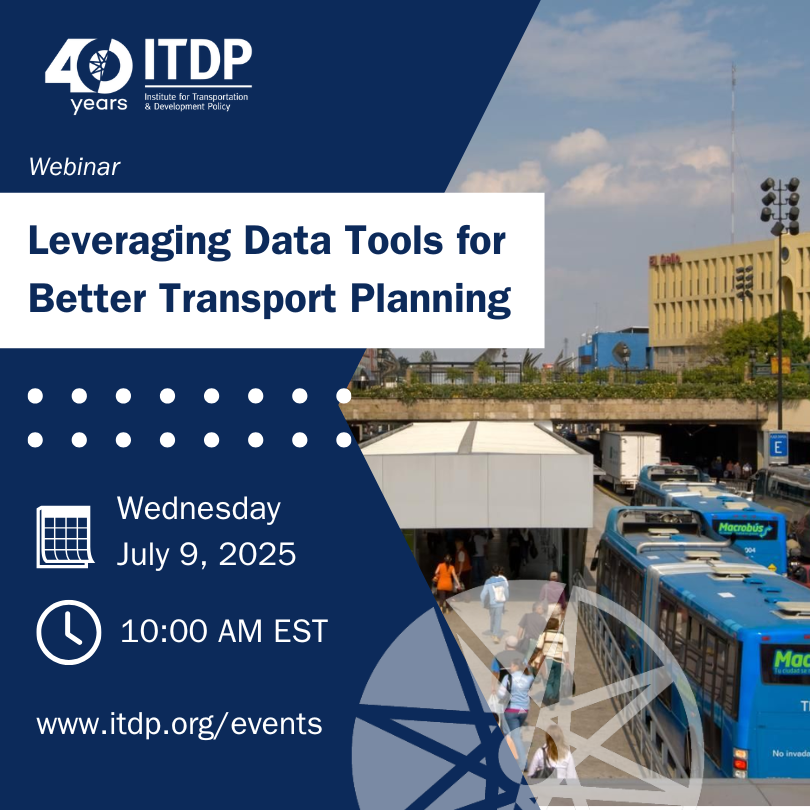
Many cities are working to develop high-quality, cost-effective, and sustainable transport systems centered on bus rapid transit (BRT) and active mobility. Advocates must overcome many challenges in the planning phases of these systems, however, including gathering initial analyses of emissions, costs, and economic impacts. Proper planning requires a kind of “scoping” to build momentum for investment and to implement systems that ensure long-term access and ridership.
Early data collection is key to implementing successful and sustainable mobility networks. This is where data-driven tools, such as ITDP’s SCOPE (scope.itdp.org), can make a significant impact. With the BRT SCOPE web tool, anyone can obtain ridership, climate, and air quality predictions for potential corridors in about 20 minutes. The web tool also makes it easy to compare and share results and is available to use in English, Spanish, and Portuguese. Beyond transit corridors, ITDP’s SCOPE models can also support planning and analysis for bike lane networks as well as parking reform policies.
In this webinar, we will highlight real-world applications of the SCOPE tool for mobility planning, data collection, and assessment in cities in Mexico and Indonesia, drawing from the experience of local ITDP teams. This session can be particularly beneficial for government officials, planners, or researchers seeking to leverage data to advocate for improvements and investments in their transportation systems. Interpretations for this webinar will be available in Spanish and Bahasa Indonesia.
Presentations
About the Presenters
Madeline Liberman
Associate - Monitoring and Evaluations, ITDP Global
Madeline (she/her/hers) is the primary staff member for ITDP’s Monitoring and Evaluations program, tracking and analyzing the organization’s projects and impacts around the world. She has previously held internships in community planning and development and urban history research. She is passionate about urban ecology and sustainability, climate and environmental justice, and GIS mapping. Madeline holds a bachelor’s degree in Urban Studies from Barnard College. In her free time, she enjoys cooking, playing the cello, and biking.

Carlos Nemesis
Urban Planning Associate II, ITDP Indonesia
Carlos Nemesis is an urban planner with expertise in Transit-Oriented Development (TOD), participatory planning, and Non-motorized Transportation (NMT). He holds a degree in Urban Planning from Institut Teknologi Bandung (ITB) and an MSc in Urban Management Development from Erasmus University, Rotterdam. Carlos has experience in researching spatial justice in planning, having worked in kampung-kota (urban village), and policy analysis, as evidenced by his master’s thesis on the use of the Land Value Capture (LVC) mechanism in TOD project. At ITDP, Carlos is responsible for topics related to push and policy under the Transport Demand Management theme. As a city dweller, he enjoys cycling and exploring every corner of the city, capturing moments with his analog camera.

Victor Medel
Public Transport and Electrification Lead, ITDP Mexico
Victor Medel is an urban planner and joined ITDP Mexico in October 2020 as part of his social service, supporting public transport and bicycle logistics projects. Since 2023, he has turned his attention to electric vehicles and public transportation planning, especially for BRT systems. He is now part of the Mobility Team and leads these projects using tools like the BRT Standard. He is also interested in other topics, such as spatial justice, active mobility, and geographic information systems.
Daniel Rodríguez Partido
Coordinator of Mobility Data and Statistics, Metropolitan Planning Institute of the Metropolitan Area of Guadalajara (IMEPLAN)
Daniel Rodríguez is the Coordinator of Mobility Data and Statistics at the Metropolitan Planning Institute of the Metropolitan Area of Guadalajara (IMEPLAN). He has led strategic projects, including the calculation of modal shift objectives for 2040 in the Sustainable Urban Mobility Plan and the development of indicators for its monitoring. He has also promoted open data policies and the public visualization of information, encouraging the use of data-driven tools for decision-making in sustainable mobility.