
November 02, 2026
Transport Electrification Is Accelerating. Are Energy Grids Ready?
Electrifying transport requires more than expanding electricity infrastructure. Coordinated planning can help cities reduce costs, strengthen energy resilience, and deliver better public transport.
Find the new Grid Policy Toolkit launched by ITDP and industry partners here.
As cities accelerate the transition to electric mobility, growing concerns about energy security, volatile fossil fuel prices, and the need to reduce emissions highlight the importance of a more integrated approach to transport electrification. Electrifying transport requires investments in grid infrastructure and stronger coordination between transport authorities, energy planners, and utilities. At the same time, investing in public transport, walking, and cycling can reduce future electricity demand and the pressure on power grids. ITDP’s Compact Cities Electrified: Energy Outlook illustrates the scale of this opportunity.
Combining electrification with investments in public transport, walking, cycling, and compact planning could eliminate the need for electricity across the six countries analyzed, which together represent approximately half of the world’s population. This could also reduce urban passenger transport electricity consumption by 44 percent by 2050. Rather than simply replacing every gasoline or diesel vehicle with an electric one, reducing vehicle trips can help limit future electricity and charging infrastructure needs while reducing exposure to energy price shocks and supply disruptions.
For public transport, grid planning matters most. E-buses depend on reliable electricity supply and charging infrastructure available at the right locations and times. Unlike private vehicles, buses operate on fixed routes and schedules, with limited flexibility to relocate depots or adjust charging operations. Grid connection delays or unexpected infrastructure costs can therefore affect not only electrification targets, but also public transport budgets and service reliability, with consequences for those who depend most on these services, including women, people with disabilities, older adults, and low-income communities. These interconnected challenges are among the issues the newly launched initiative addresses, which provides practical policy recommendations and case examples for more integrated and effective grid planning.
Learn more about electrification’s role in ITDP’s 2030 Strategic Plan.
Aligning Transport and Grid Planning
The transition to electric transport is increasing demand on electricity systems, but energy supply and delivery plans often don’t account for it. Transport agencies, responsible for bus fleet electrification, may set ambitious transition targets without fully accounting for the required electricity infrastructure. Meanwhile, utilities responsible for grid planning often develop electricity demand forecasts without adequately accounting for future bus fleets, charging depots, or other concentrated transport loads.
This disconnect can create significant challenges. Grid upgrades may take years to complete, while transport authorities and operators work under shorter procurement timelines. In many cities, fragmented responsibilities, permitting requirements, and unclear procedures further complicate the connection of charging infrastructure. For public transport, grid readiness cannot be treated as an afterthought. Fleet planning must consider charging infrastructure and electricity supply from the earliest stages, alongside route characteristics, service requirements, depot locations, and vehicle technologies.
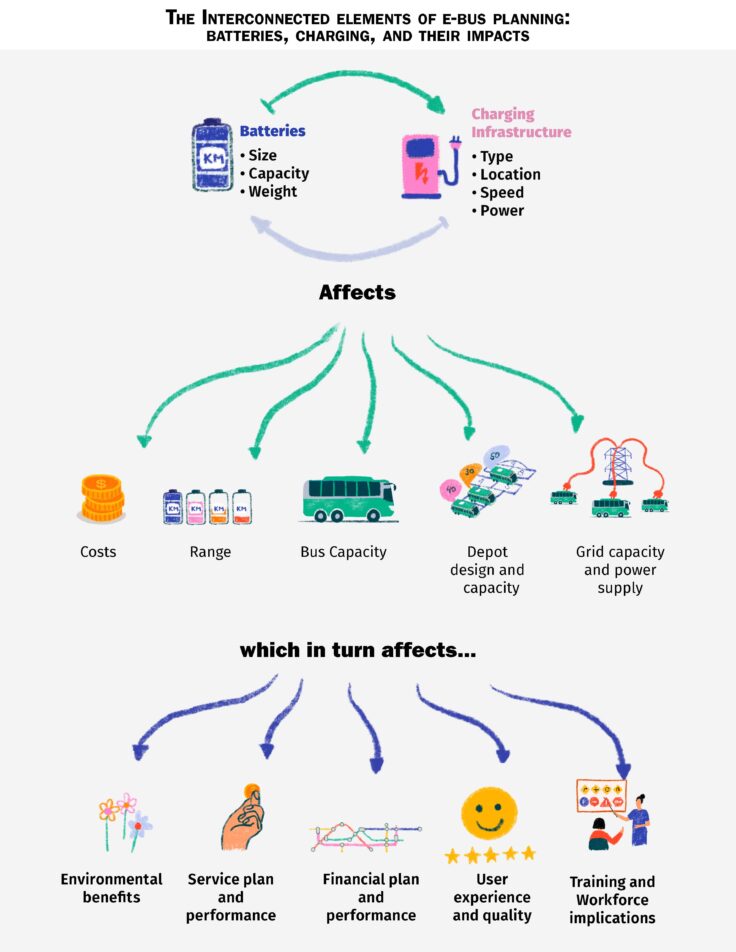
ITDP’s Advancing E-Buses: A Guide to Batteries and Charging highlights the importance of this integrated approach. Selecting the right charging technology and developing a charging strategy are not isolated from technical decisions. They affect fleet operations, infrastructure investments, and the transition’s financial sustainability. Beyond technical planning, the transition raises important questions about how new infrastructure is financed, owned, operated, and maintained. Different business models shape how transport authorities, bus operators, charging providers, utilities, and investors share responsibilities, costs, and risks. These arrangements must be coordinated to align infrastructure investments with fleet deployment and operational needs.
ITDP recently published Financing the E-Bus Transition: Improving Project Bankability and Enabling Scale, which explains how different business models, financing mechanisms, and risk-sharing arrangements can support more financially viable e-bus systems. These considerations are particularly important in emerging economies, where limited institutional and financial capacity, especially among smaller operators, can make unpredictable infrastructure costs a major barrier to electrification and place additional pressure on public transport affordability and service quality.
What Better Grid Planning Requires
Addressing these challenges requires shifting from reactive to anticipatory grid planning to better align fleet deployment with grid development timelines. Rather than waiting for charging infrastructure projects to request connections, utilities and public authorities need to anticipate where and when transport electrification will create demand. Transport and energy policies need to be developed together, supported by shared demand projections, coordinated investments, and a clear understanding of future infrastructure needs.
Anticipatory grid planning should also account for how transport policies can shape future electricity demand. Projections based primarily on growing electric vehicle ownership may overlook how investments in public transport, walking, cycling, and compact urban development can reduce vehicle numbers and the electricity required to power them. Integrating different transport scenarios into energy planning can help governments better anticipate infrastructure needs and avoid unnecessary investments.
Alongside efforts to reduce future energy demand, charging strategies can help use existing electricity infrastructure more efficiently. For example, e-bus depots may schedule charging during off-peak hours or when more renewable energy is available, if they meet operational requirements. Smart charging, appropriate electricity tariffs, and complementary technologies such as on-site solar generation and battery storage can help manage peak demand, reduce charging costs, and use existing grid infrastructure more efficiently. With appropriate charging strategies, electric vehicles can become valuable sources of flexibility and potential revenue.
Clear institutional responsibilities, appropriate regulatory frameworks, and access to reliable data are also essential. The report addresses these challenges through practical recommendations and case examples covering grid planning, deployment, operations, and the institutional and regulatory conditions needed to support them. It reinforces an important lesson: successful transport electrification depends as much on effective policies, institutions, and coordination as it does on technological advances.

Ethiopia: An Emerging Example
Ethiopia’s recent transport policies offer a lesson for others seeking to advance electric mobility while also considering impacts on their energy systems. Driven in part by concerns over fossil fuel imports and energy security, the country introduced restrictions on imports of conventional combustion-engine vehicles in 2024 and has since expanded its electric mobility ambitions. Public transport electrification is also advancing, with approximately 396 electric buses nationwide and plans for further expansion. This transition created new demands on electricity infrastructure.
Limited charging infrastructure, concerns around grid reliability and future capacity, and insufficient coordination between transport authorities and utilities remain important barriers to scaling up e-buses. Ethiopia’s E-Mobility Strategy 2025-2030 recognizes these challenges and prioritizes grid strengthening, charging infrastructure expansion, smart charging, and stronger institutional coordination. The country’s National Non-Motorized Transport Strategy 2025–2028 sets major targets for safer pedestrian and cycling networks, including 600 kilometers of walkways and 200 kilometers of cycling lanes in Addis Ababa.
By making walking and cycling safer, more convenient, and more accessible, these investments can help people meet their daily travel needs without relying on private vehicles, electric or otherwise. Together, these policies point toward a more efficient approach to transport electrification: reducing unnecessary energy demand while electrifying only the trips that still require motorized transport. This matters as Ethiopia expands electricity access while building out its EV charging network. Electrification remains essential, but pairing it with investments in public transport, walking, and cycling can help ensure a cleaner, more energy-efficient transport system.
Find more of ITDP resources on public transport electrification here.
Planning for a More Resilient Future
The growing urgency of the energy transition shows why grid modernization should not be treated as a response to rising electricity demand. It is also an opportunity to rethink how transport and energy systems are planned together, ensuring that investments support more efficient, affordable, and resilient mobility. Combining electrification with a shift toward more sustainable transport modes could reduce gross oil and gas imports by 11 to 57 percent by 2050, depending on the country, and avoid about 2.5 billion barrels of oil in annual imports across the countries analyzed.
These benefits extend beyond emissions reductions, helping countries reduce their dependence on fossil fuels and exposure to volatile energy markets. For public transport, this means looking beyond vehicle deployment to the institutional, financial, and operational conditions needed to electrify at scale. It also means ensuring that the costs and benefits of the transition are distributed fairly, particularly for smaller operators and communities that depend most on public transport.
Ultimately, preparing electricity grids for transport electrification is not only about expanding capacity to accommodate more electric vehicles. It also requires recognizing that transport policies can fundamentally shape future electricity demand. A transition focused only on replacing fossil-fuel vehicles risks putting greater pressure on electricity systems than one that also reduces dependence on private cars. By considering how to manage and reduce electricity demand, governments can invest more strategically and support a more affordable, efficient, and resilient energy transition.
The Grid Policy Toolkit offers practical recommendations to help policymakers and practitioners move toward this more integrated approach.