
May 01, 2026
Why All Cities Need Well-Managed, Well-Funded Public Transport
Well-managed and well-funded public transport systems are essential for meeting the economic, social, and environmental needs of today’s cities.
Read more about ITDP’s definitions and essential qualities for good public transport systems.
As cities continue to grow and travel patterns evolve, the ability of public transport to deliver reliable, affordable, and sustainable mobility depends on two foundational pillars: strong management and stable, long-term funding. Without both together, even the most ambitious transit planning and policies will struggle to meet the needs of everyday people. At its core, a well-managed public transport system operates as a unified, integrated network rather than a collection of disconnected services. It should be designed to be reliable, frequent, comfortable, and easy to use, adapting to changing demand and supporting a wide range of daily needs, from regular commuting to caregiving activities.
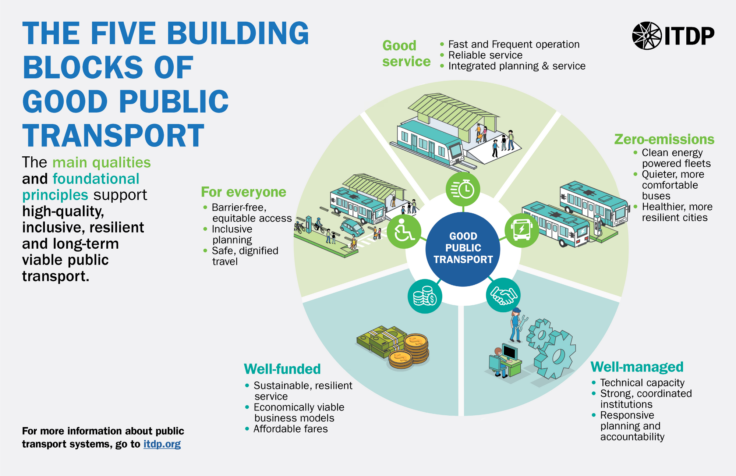
Achieving this level of service requires more than technical planning; it depends on strong governance frameworks that clearly define roles and responsibilities across agencies and levels of government. When institutions are aligned and mandates are well understood, decision-making becomes more strategic, coordination improves, and the long-term performance of systems is strengthened. ITDP’s Building Better Public Transport Systems: Public Transport Principles offers a shared framework to help governments, planners, and advocates understand what good public transport is, and what is required to ensure systems are better managed and better funded for the future.
Why Well-Managed?
Effective management also means treating public transport as a cohesive system. Areas such as planning, regulation, financing, infrastructure provision, service contracting, and performance monitoring must work in tandem rather than in silos. In many cities, local governments are best positioned to oversee day-to-day operations and tailor services to community needs. At the same time, regional or national authorities play key roles in coordinating across jurisdictions, setting standards, and ensuring consistent funding. Matching responsibilities to the appropriate level of government is critical for maintaining accountability and delivering results on a larger scale.
At the same time, well-managed systems increasingly rely on strategic partnerships with the private sector. Private operators and technology providers can contribute to improving service delivery, digital fare systems, and data collection, thereby improving efficiency and user experience. However, these partnerships must be carefully structured, with transparent contracts and strong public oversight to ensure that private incentives align with public goals. Without this, systems risk fragmentation, inequity, or diminished service quality.
Equally important are the investments into institutional and workforce capacity. As public transport systems adopt new technologies — such as zero-emission vehicles, advanced safety systems, and digital tools — the transit workforce must be equipped with the skills to manage and operate them effectively. Continuous training, updated curricula, and on-the-job learning are essential to building the technical expertise needed for long-term success. Strong institutions, backed by capable professionals, are the backbone of any high-performing public transport system.
Watch the “Building Better Public Transport Networks for All” webinar in more languages here.
Why Well-Funded?
Even the best-managed systems cannot function without adequate and reliable sources of funding. A well-funded public transport system has the financial capacity to provide consistent, high-quality service over time, ensuring that people can depend on transit without fear of sudden fare increases or service cuts. This stability requires resources not only for upfront capital investments (such as vehicles and infrastructure) but also for ongoing operations, including maintenance, staffing, and system upgrades.
In today’s rapidly changing world, relying solely on traditional revenue sources such as fares is no longer sufficient to sustain public transport. Successful systems diversify their funding streams by combining public subsidies with innovative strategies, including employer contributions, parking levies, congestion charges, advertising, and land value capture. These mechanisms not only strengthen financial sustainability but can also support broader policy goals, such as reducing car dependence and promoting more efficient land use.
Public funding plays a particularly important role in systems where services are delivered through private contracts. In these cases, governments are responsible for ensuring predictable, stable payments that underpin service quality and affordability. At the same time, financing instruments (such as loans, bonds, and climate funds) allow cities to access capital for large-scale investments and repay it over time. When used strategically, financing can accelerate transformative projects like fleet electrification or network expansion, while stable funding ensures their long-term viability.
A shared understanding of the foundations of good public transport is key to ITDP’s vision for increasing ridership worldwide.

Strong financial management and institutional capacity are essential to making these approaches work. Transport agencies must be able to manage budgets transparently, procure services efficiently, and monitor outcomes effectively. This is especially important when engaging private partners, as poorly structured agreements can create long-term financial risks. Clear accountability and robust oversight mechanisms help build public trust and ensure that investments deliver tangible benefits.
Good Public Transport Everywhere
Ultimately, well-managed and well-funded public transport systems are about more than mobility; they are the cornerstone of inclusive, healthy, and prosperous cities. When supported by strong governance and sustainable financing, public transport can expand access to economic opportunities, reduce emissions, improve air quality, and enhance the quality of life for millions of people.
These systems are most effective when integrated into broader urban policies that prioritize compact development, walking, cycling, and electric vehicles. Delivering this vision is not without challenges. Political volatility, resource constraints, and institutional complexity can slow progress. However, cities that commit to making practical, incremental improvements while aligning stakeholders around shared goals can lay the groundwork for transformative public transport.
With sustained political will, cross-sector collaboration, and a clear vision, well-managed and well-funded public transport can be a reality in every city around the world.