
February 12, 2026
Egypt Prioritizes People-Centered Cities with Active Mobility Strategy
In a landmark move toward more sustainable urban development, the Government of Egypt launched an Egypt Active Mobility Strategy 2025–2034 with ITDP Africa’s support, offering a comprehensive national framework designed to transform how people move within cities.
Integrating walking and cycling with transit is vital to ITDP’s vision for increasing public transport ridership worldwide.
The Strategy redefines the role of walking and cycling in Egypt’s transport system, placing people, rather than vehicles, at the heart of future urban mobility planning. Despite widespread walking and cycling, many Egyptian cities remain dominated by motorized traffic. Streets are often designed for cars, with limited infrastructure for pedestrians or cyclists. This imbalance has led to chronic congestion, poor air quality, and unsafe road conditions, all of which have become defining features of urban life in Cairo, Alexandria, and other growing cities.
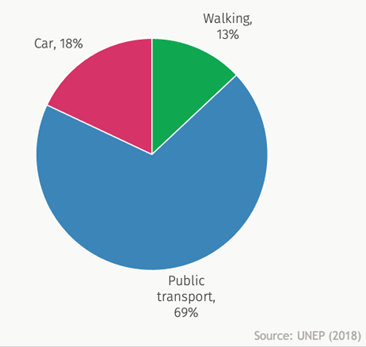 For many Egyptians, walking is not a lifestyle choice but a necessity: it is how millions access schools, shops, transit hubs, and workplaces each day. Nearly 13% of commuting trips are done by walking (see mode share graphic). Yet pedestrians and cyclists face fragmented sidewalks, limited crossings, and unsafe intersections. These challenges disproportionately affect women, children, older adults, and people with disabilities, who are more vulnerable to unsafe street conditions and social exclusion.
Reimagining Streets with a Collaborative Vision
The Egypt Active Mobility Strategy signals a decisive policy shift nationally, viewing walking and cycling not as secondary or informal modes, but as essential pillars of a safe, efficient, and climate-aligned transport system. The Strategy was developed through a collaborative effort led by ITDP Africa alongside Egypt’s Ministry of Housing, Utilities, and Urban Communities (MoHUUC), the New Urban Communities Authority (NUCA), the UN Environment Programme (UNEP), and UN-Habitat. Together, these partners have created a framework that aligns active mobility with Egypt’s broader sustainable development and climate commitments, including its Nationally Determined Contribution (NDC) under the Paris Agreement.
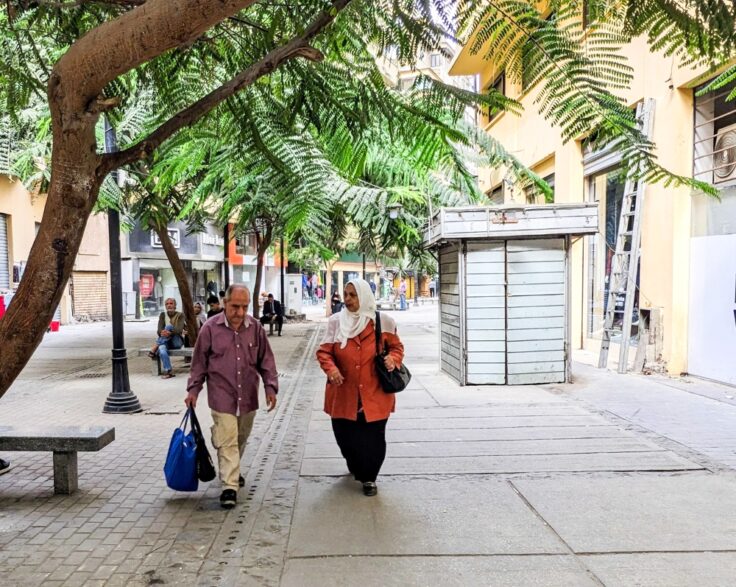
The Strategy further establishes a clear national vision and measurable targets to increase the mode share of walking and cycling, reduce car dependence, and improve road safety and air quality. It outlines principles for “complete streets” that safely accommodate all users, from pedestrians and cyclists to public transport riders and motorists. It also introduces national design standards for sidewalks, crossings, cycle tracks, intersections, and street lighting, providing a unified framework for local governments and developers.
Mainstreaming Inclusivity and Safety
A key feature of the Strategy is its focus on gender-responsive and inclusive planning. Women and girls often face unique barriers to mobility, including inadequate street lighting, safety concerns, and cultural expectations that limit independent travel. By embedding inclusivity in infrastructure design and policy, the Strategy aims to create safer, more welcoming environments for all users. Accessibility for people with disabilities and older adults is also a central consideration. The Strategy promotes universal design standards, ensuring that everyone can move through the city comfortably, whether on foot, by wheelchair, or with mobility aids. The Strategy provides detailed guidance on implementation, clarifying institutional roles, capacity-building needs, and monitoring frameworks.
The plan further identifies investment priorities and proposes mechanisms for coordinated financing, helping cities and agencies align budgets and programs under a shared national framework. By 2034, the Strategy envisions Egyptian cities with interconnected, safe, and inclusive walking and cycling networks. Achieving this vision will require a mix of high-quality pedestrian and cycling infrastructure, improved street management, expanded bikeshare systems, and sustained community engagement. These efforts will complement ongoing investments in public transport, such as Cairo’s expanding metro network and new bus rapid transit corridors, helping to create integrated, multimodal transport systems in which walking and cycling serve as natural extensions of transit.

Moving National Policy Forward
Egypt’s urban areas are growing rapidly, with new communities emerging across the Greater Cairo Region and beyond. Integrating active mobility early in this growth process is both a climate imperative and an economic opportunity. Encouraging walking and cycling reduces congestion, lowers emissions, and improves public health, all while enhancing urban livability and local economies. Globally, cities that invest in active mobility infrastructure see tangible returns: cleaner air, reduced health costs, and more vibrant street life. In Egypt, where transport accounts for a significant share of urban emissions and energy use, expanding active mobility will be crucial for meeting national sustainability targets and improving the quality of life.
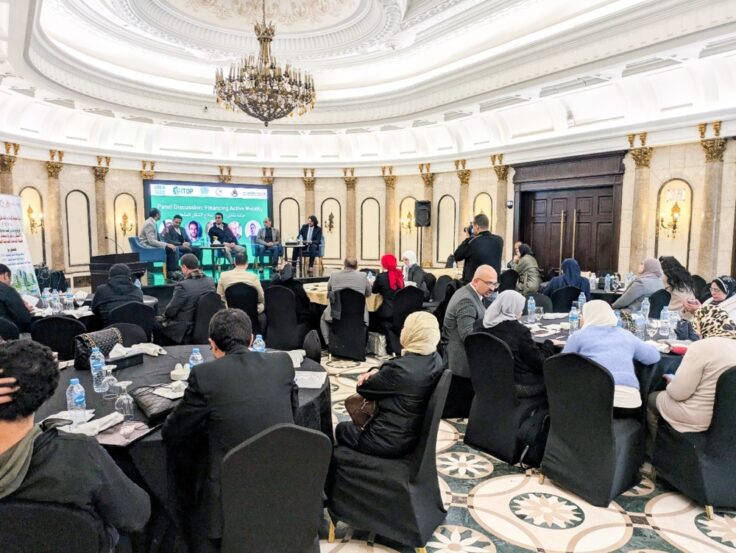
The launch of the Egypt Active Mobility Strategy 2025–2034 marks a collective step forward, underscoring Egypt’s commitment to improving urban spaces for all. During the launch event, discussions focused on how manuals and design codes can support the implementation and scaling of non-motorized transport (NMT) infrastructure. Participants highlighted that unified codes would help build a common understanding of NMT components, and that integrating these standards with implementing agencies will enable Egyptian cities to scale up their walking and cycling networks. Participants also embraced this strategy as a catalyst. Along with other guidelines and codes, decision-makers can be incentivized to design and implement more active mobility initiatives in both old and new cities.
Stakeholders at the event also highlighted the growing importance of active mobility infrastructure for helping to address the dual challenges of population growth and urban sprawl. Some participants mentioned that one of the main benefits of the Strategy is the implementation plans for several goals. Setting goals for cities of different scales provides decision-makers and planners with practical guidance for short- and long-term strategies. In addition, turning these policies into tangible infrastructure is a powerful mechanism to spur funding for public-private investments that is crucial to future progress.
Learn more about the Strategy’s launch event in Cairo, which was supported by ITDP Africa.
By centering people and sustainability in transport policy, Egypt is taking a bold step toward building healthier, more inclusive, and more resilient cities.
As implementation begins over the next decade, this Strategy aims to provide a clear roadmap for transforming the mobility and lives of millions of Egyptians.