Building Better Public Transport Systems: Public Transport Principles
About
Public transport is a vital part of cities, connecting people to jobs, education, healthcare, and other opportunities. In most cities around the world, public transport — both formal and informal — accounts for the majority of motorized trips, from 40% to 70%. In well-planned cities, public transport supported by walking and cycling enables vibrant, compact, and connected urban areas, making them more livable and efficient for all.
Despite its benefits, public transport has faced increasing challenges in recent years. Addressing these challenges requires increased funding, strategic partnerships and global knowledge-sharing to ensure that both well-established and fast-growing cities can build resilient, adaptable, and high-quality public transport. This is alignment is crucial as ITDP works towards massively increasing public transport ridership in all key regions.
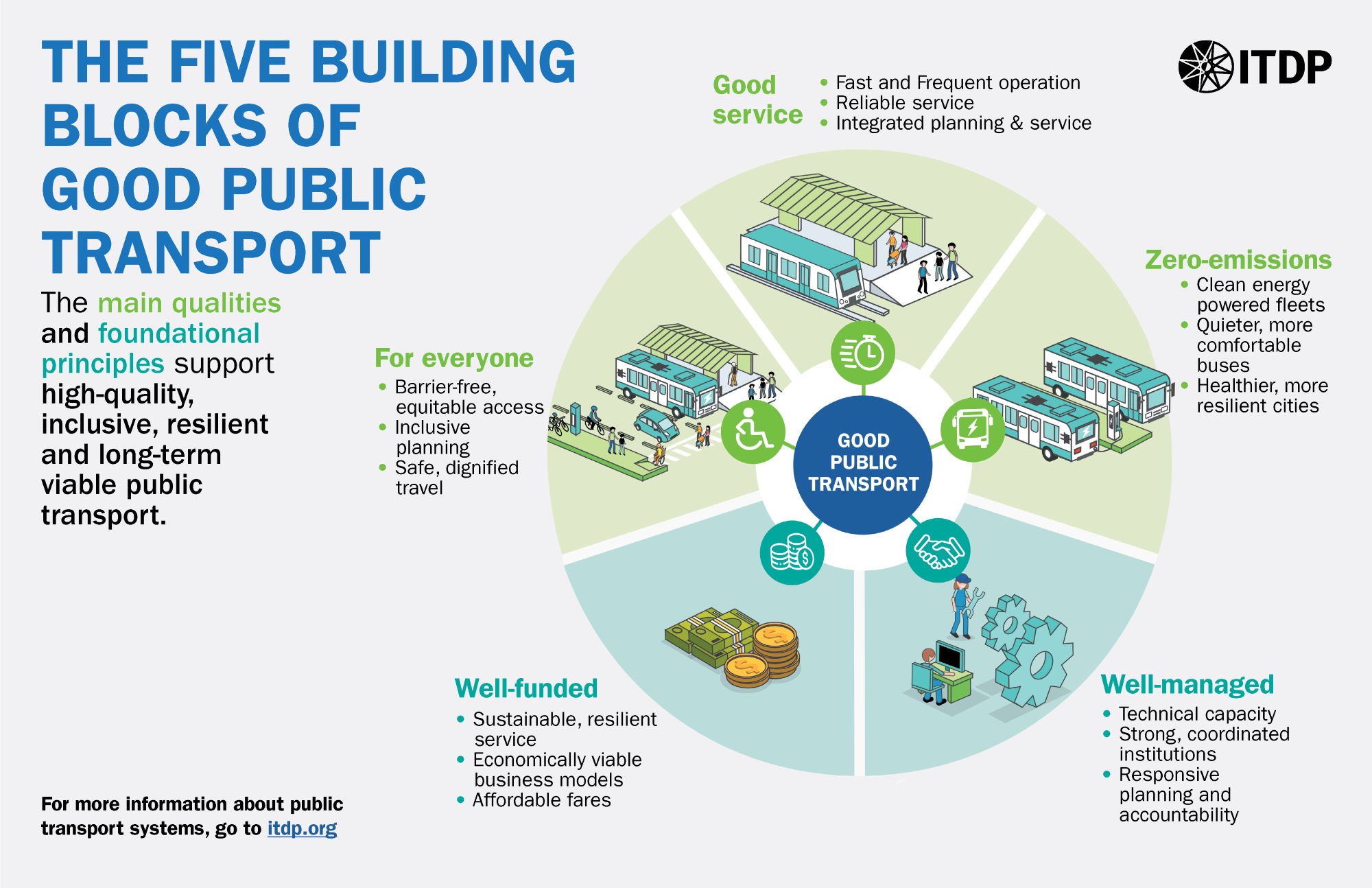
This publication presents ITDP’s Public Transport Principles brief — a shared framework to guide governments, planners, and advocates in designing public transport systems that deliver good service, with zero-emissions vehicles for everyone, grounded in well-managed institutions and well-funded operations. These five principles (good service; zero-emissions; well-funded; well-managed; for everyone) define what makes good public transport services effective, equitable, and transformative and how to achieve them in cities.
Rather than prescribing one-size-fits-all solutions, this brief also offers adaptable principles grounded in global experience. It can be used to inform policy development, align stakeholder efforts, and support more consistent evaluation of what constitutes “good public transport.” Translations of the brief in additional languages are also upcoming.
Learn More
- Continue Reading on the ITDP Blog →
- Watch the “Building Better Public Transport Networks for All” webinar →
- Download the “Building Blocks of Good Public Transport” infographic →
- Learn more about ITDP’s 2030 Strategic Plan →
- Download ITDP’s “Taming Traffic” report →
- Download ITDP’s “Advancing E-Buses” guide →
- Explore ITDP’s Atlas of Sustainable City Transport platform →
Download ↓