
October 01, 2026
How Companies Are Transforming Commutes in Mexico City
For many workers in Mexico City, the daily journey to and from work is shaped by congestion, long travel times, and limited transportation options.
Read a version of this article in Spanish from ITDP Mexico.
Addressing these challenges requires more than expanding transportation infrastructure. It also means rethinking how workplaces influence travel behavior and how employers can work together to make sustainable mobility a practical choice. After six years of implementation, MOVIN Reforma, an inter-company mobility initiative led by ITDP Mexico and CoRe Livable and Friendly Cities, along with AT&T Mexico, BBVA Mexico, and Grupo Kaluz, has shown the potential of coordinated employer action to transform daily commutes.
MOVIN was part of the Ideamos program convened by ITDP Mexico, which promoted a sustainable and inclusive mobility ecosystem centered on people and their right to move safely. Launched in 2020, Ideamos generated several innovative mobility pilot projects in collaboration with Transport Network Companies (ERTs), authorities, private initiatives, and civil society organizations. MOVIN itself aimed to improve how employees travel to workplaces along Paseo de la Reforma, one of Mexico City’s major employment corridors. Its experience offers lessons for other companies and employment centers seeking to reduce car dependence, lower emissions, and improve the quality of workers’ daily journeys.
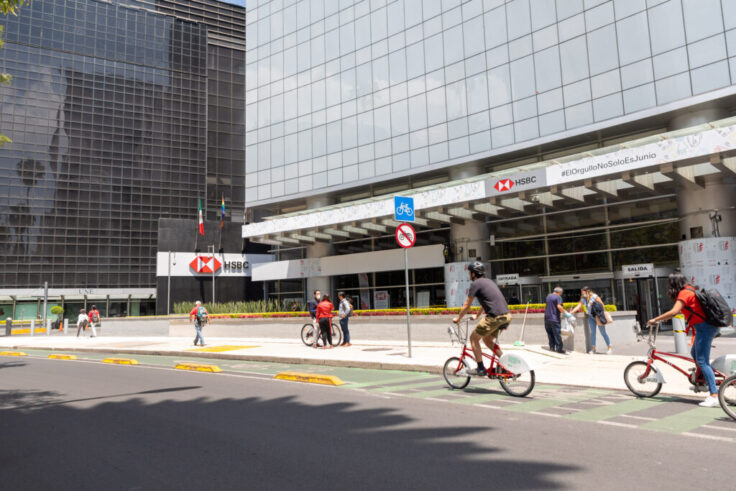
Shifting commutes away from private vehicles and towards sustainable modes is key to ITDP’s strategic vision.
MOVIN Reforma began in 2019 with a detailed diagnosis of employee travel patterns and mobility needs. The work was formalized in 2022 through an Institutional Mobility Plan (Plan de Movilidad Institucional, or PMI) presented to Mexico City authorities. The PMI approach recognizes that companies can play an important role in managing the travel demand they generate. Rather than addressing employee mobility separately, MOVIN Reforma brought neighboring businesses together to identify common challenges and develop coordinated solutions.
The results demonstrate the potential of this approach. Over the course of the initiative, MOVIN Reforma achieved a 30 percent reduction in pollution emissions associated with employee travel and a 32 percent reduction in kilometers traveled by private car. At the same time, bicycle trips doubled, supported by road safety workshops, bicycle schools, and subsidies for Ecobici memberships.
The program also encouraged wider adoption of hybrid work arrangements and directly supported employees who used public transportation. Together, these measures show how employers can combine workplace policies, incentives, and transportation options to reduce dependence on private cars. MOVIN Reforma’s experience highlights an important lesson: individual companies cannot address workplace mobility alone. Sustained engagement from senior management, collaboration between the private sector and civil society, and consistent communication with employees supported the initiative’s progress.
Learn more about MOVIN in this 2022 discussion that convened ITDP Mexico, key partners, and high-level policymakers.
These elements helped translate mobility goals into changes in everyday travel behavior. The program also opened broader conversations about the policies and regulations needed to support employer-led mobility initiatives, including greater flexibility in regulatory frameworks and stronger tools for corporate shared transportation. These lessons could be particularly valuable as cities develop new employment centers and industrial parks. Large concentrations of workers can generate significant travel demand, making mobility planning an important consideration from the earliest stages of development.
The conclusion of MOVIN Reforma provides an opportunity to apply its lessons to other workplaces, employment centers, and cities. Institutional Mobility Plans can help companies understand how their employees travel, identify barriers to sustainable transportation, and develop targeted measures to address them. When several organizations in the same area coordinate their efforts, these measures can have a broader impact while creating more consistent transportation options for workers. The program’s lessons also demonstrate the value of stronger coordination between the private sector and local governments to make a tangible impact on everyday urban mobility.
“When a new industrial park is planned where 20,000 people or more will arrive, why not require, within the planning, an Institutional Mobility Plan shared between neighboring companies? There is a great opportunity there. Without MOVIN, we would not have the arguments to know that this does work.”
— Gonzalo Peón, Executive Director, ITDP Mexico