
August 17, 2026
Brazil’s Chance to Choose a Different Path for its Urban Mobility
In July, BNDES (Brazil’s federal development bank) and the country’s Ministry of Cities released the National Urban Mobility Study (ENMU), a comprehensive analysis of what it would take to pull Brazil’s public transport systems out of decades of stagnation.
By Clarisse Cunha Linke, Executive Director, ITDP Brazil
Read the original piece in Portuguese here.
On the same day as the ENMU launch, the government announced a gradual phase-out of fuel subsidies, beginning with the end of the diesel discount, after international oil prices stabilized somewhat following the first ceasefire in the 2026 Iran conflict. These two seemingly unrelated announcements actually raised the same question: where will Brazil direct public funds for mobility over the next 20 years? The ENMU is no longer just a report to be shelved. It is a portfolio: nearly 190 medium- and high-capacity public transportation projects, including subways, light rail, bus rapid transit (BRT), and bus corridors, for the country’s 21 largest metropolitan areas where approximately 42% of the Brazilian population lives.
That represents more than 3,000 kilometers of network, of which 2,400 kilometers are new sections — a 120% expansion over what exists today. The required investment for these projects exceeds R$430 billion (~USD 82.6 billion), but the study is unequivocal: this goal is achievable. It would be sufficient to increase the average annual investment by 0.15 percentage points of the national GDP, raising it from around 0.10% to approximately 0.25%, to complete the portfolio in just over two decades.
In practical terms — as Luciene Machado, the Superintendent of Project Structuring at BNDES, explained at the study’s launch event — this amounts to roughly R$20 billion (~USD 3.8 billion) per year, which is a figure comparable to other investment priorities already secured in the federal budget. The central point of Luciene’s remarks was another, more important one: what is lacking is not the amount itself, but rather a predictable, stable, and sufficient financing structure — the opposite of what the sector has today, with subsidies often granted in a fragmented manner and metropolitan systems operating at their limits.
Nelson Barbosa, Director of Planning and Project Structuring at the BNDES, summed up this inflection point with a simple statement. Until recently, “there was funding, but no projects.” Now, however, “there is funding, and there are projects.”
Read more about ITDP’s vision for increasing ridership on well-funded, well-managed public transport.
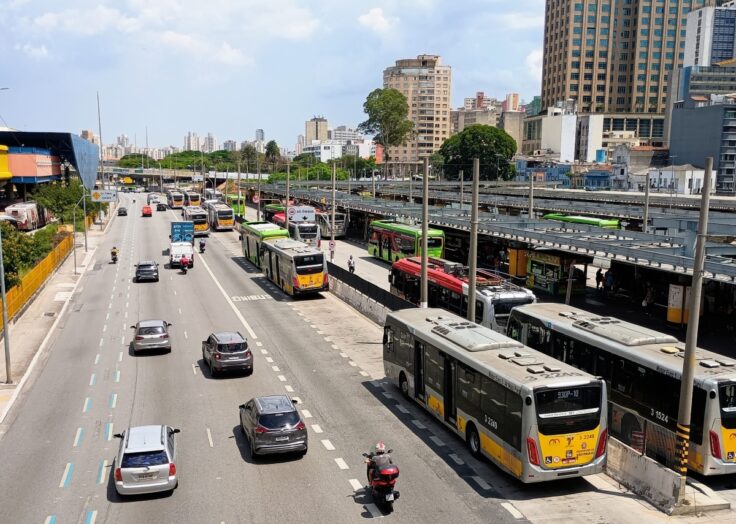
This investment in urban mobility can represent a real leap forward, with significant returns: a reduction of up to 15% in average travel time, the prevention of more than 27,000 traffic fatalities per year, an 11% drop in cost per trip, a 12% reduction in CO2 emissions, and an increase of up to 40% in access to jobs and services. In total, the estimated social value exceeds R$400 billion (~USD 76.9 billion), not counting the industrial impact: demand for up to 6,600 new electric buses and the creation of up to 1.3 million jobs per year during implementation. ITDP Brazil served as a key technical partner in the network of institutions that supported the ENMU, particularly in defining indicators that help consistently measure the effectiveness of mobility policies in metropolitan regions.
This role reinforces something we at ITDP believe in: good data and good indicators are part of the institutional infrastructure that underpins sound investment decisions. And this is precisely where these two announcements in July converge. A robust portfolio of projects, with structured financing and legal certainty to attract concessions and public-private partnerships (PPPs), is necessary. But that alone is not sufficient to reverse decades of declining ridership in public transport. Targeted policies that increase the number of people who choose to take the train, the subway, and the bus are the only real path towards more resilient and inclusive Brazilian cities.
Good infrastructure is the indispensable first step in this equation: without a network, without integration, and without traffic priority, no public transport service is attractive enough to compete with a private vehicle. But infrastructure without a coherent subsidy policy is a house built on sand. That is why the news of the gradual phase-out of fuel subsidies should be viewed as both a positive sign and a warning. Positive because it is a step — albeit a tentative one and a reaction to external circumstances — toward ending the artificial financing of car dependence. It also serves as a warning because Brazil still lacks a unified government message about what it truly wants to prioritize for urban mobility.
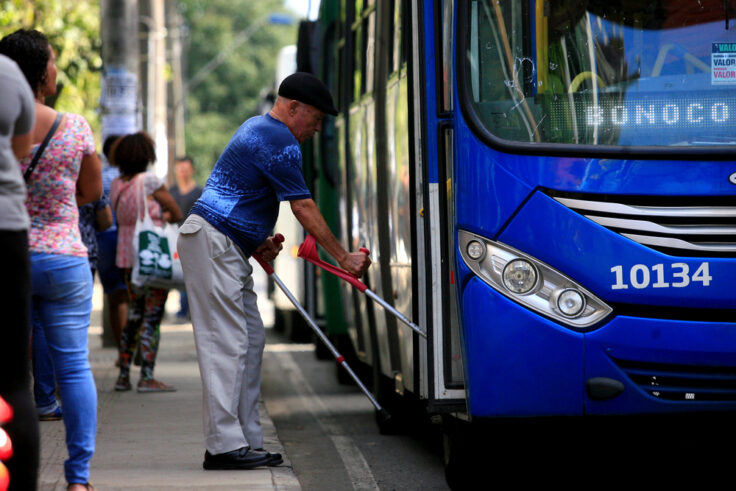
Reducing Brazil’s diesel subsidy, driven by fiscal constraints and oil price volatility, is not enough if tax exemptions and easy credits remain available for purchasing private vehicles. In addition, the deregulation of ride-hailing services and road infrastructure investments continue to subsidize (silently but far more generously) individual motorized transportation, cars, and, increasingly, motorcycles. For the first time in a long time, the ENMU provides the country with a portfolio of projects and a plausible financing plan to improve public transportation so that everyone can prioritize it.
The question that remains now is whether the Brazilian government as a whole — not just BNDES and the Ministry of Cities, but also the Ministries of Finance, Planning, Mines and Energy, and Industry — is willing to align on this path for the transport sector with a clear policy decision: to stop subsidizing the problem in order to finance the solution. The funding is there; the projects are there.
What Brazil needs now is the courage to choose, explicitly and in a coordinated way, the kind of future we want for our cities.