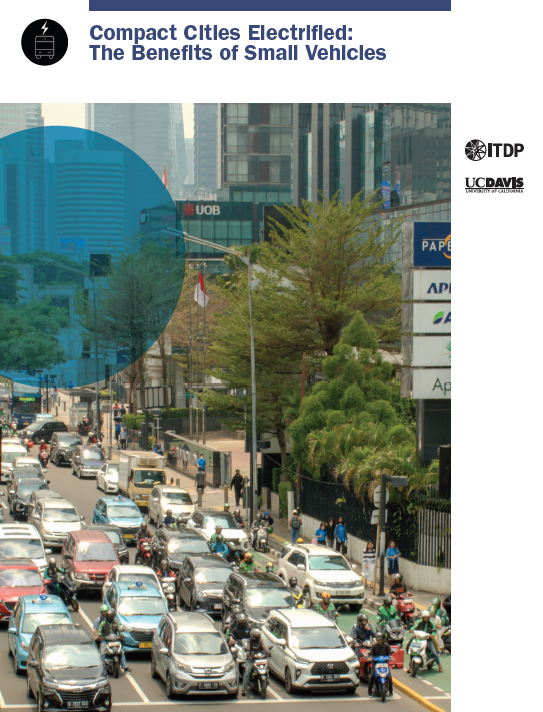
Compact Cities Electrified: The Benefits of Small Vehicles
About
This publication from ITDP and UC Davis, supported by the FIA Foundation, presents a first of its kind global and country-level analysis of how growing vehicle sizes are shaping urban passenger transport — and what that means for road safety, energy use, battery demand, and greenhouse gas emissions. Focusing on Brazil, China, India, Indonesia, Mexico, and the United States, the study models five plausible 2050 scenarios: Business-as-Usual (BAU), Mode Shift, High Electric Vehicles (EVs), Small Vehicles, and a combined Shift+EVs+Small Vehicles pathway.
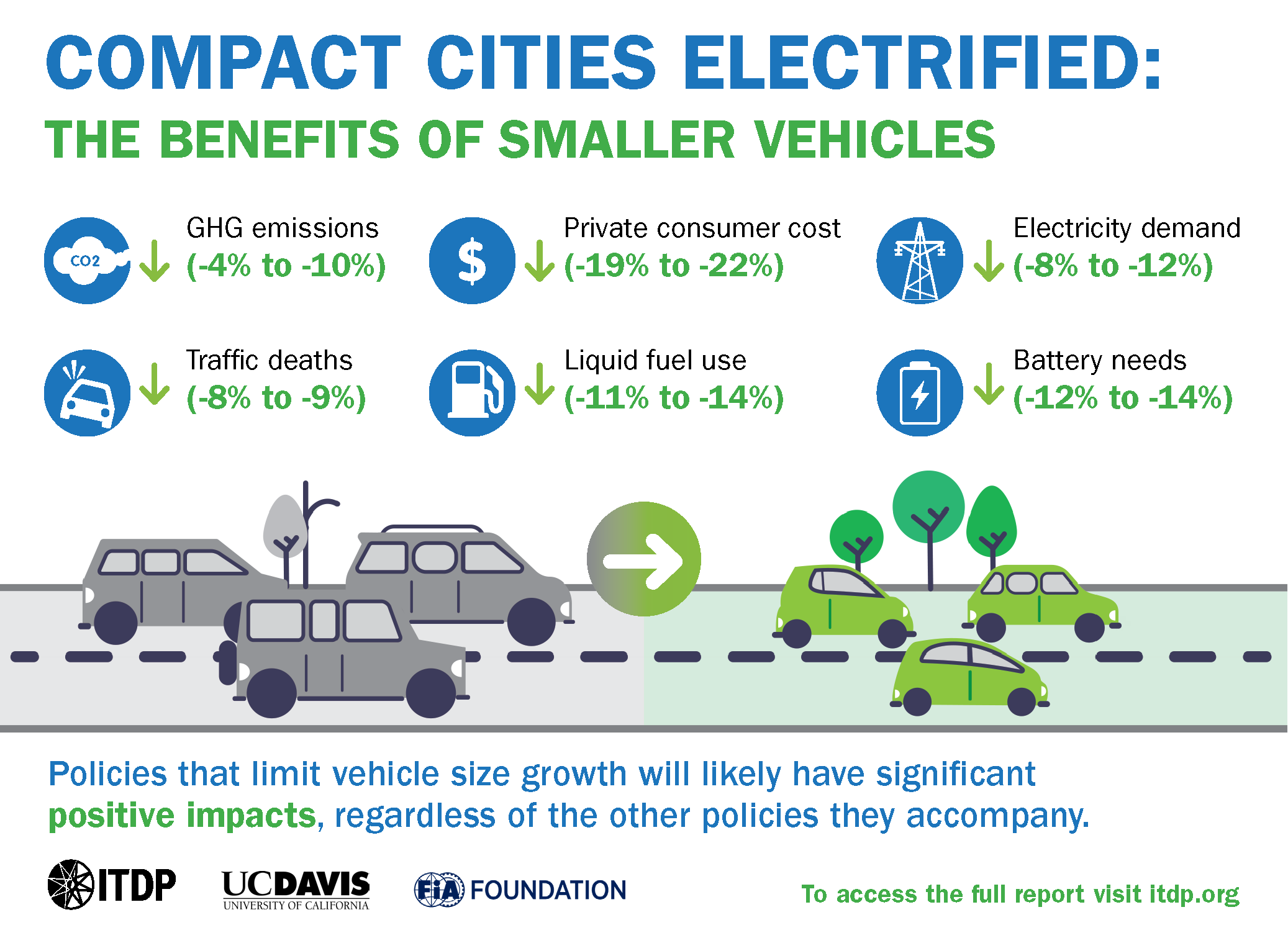
With SUVs and other larger vehicles continuing to rise in global sales, these findings underscore the many benefits of limiting this trend. Across the countries analyzed, limiting vehicle size growth can deliver consistent benefits, including reductions in consumer costs, fuel use, electricity demand, battery needs, traffic deaths, and overall emissions. Prioritizing policies for sustainable urban mobility and mode shift is core to ITDP’s vision for increasing ridership across zero-emission, well-funded public transport systems.
The research finds that combining Mode Shift, High EV Adoption, and Small Vehicles delivers the greatest positive impacts. Together, these strategies can reduce overall energy consumption and liquid fuel use, while keeping battery demand manageable and accelerating a transition to cleaner transport. The combined scenario can cut annual GHG emissions by more than two-thirds by 2050, aligning closely with global climate targets.
At the same time, prioritizing Mode Shift could save up to 1.5 million lives and reduce annual road deaths by 40% through 2050, while significantly lowering fine particulate pollution (PM2.5) when paired with vehicle electrification. Economically, the report findings offer a compelling alternative to BAU — which will drive steep cost increases in rapidly growing economies — by showing that these integrated strategies can cut total public and private costs in half. By identifying vehicle size as a decisive and actionable policy lever, this publication provides a new, evidence-based roadmap for delivering cleaner, safer, and more equitable urban mobility.
Learn More
- Continue Reading on the ITDP Blog →
- Watch the “Benefits of Small Vehicles” webinar →
- Read “How to Keep SUVs Out of Emerging Economies” →
- Download the “Benefits of Smaller Vehicles” infographic →
- Download the “Air Quality Impacts of Urban Passenger Transport Reform” brief →
- Download ITDP’s original “Compact Cities Electrified” report series →
- Explore ITDP’s Atlas of Sustainable City Transport for mobility indicators →
- Learn more about ITDP’s 2030 Strategic Plan →
Download ↓