
February 17, 2026
Defining Public Transport and its Vital Role in Today’s Cities
Public transport is more than just a way to get from one place to another.
Learn more about ITDP’s vision for increasing public transport ridership in all of our key regions.
It is the lifeline of every city, connecting people to jobs, education, healthcare, and social opportunities. In most urban areas around the world, public transport, both formal and informal, accounts for between 40% and 70% of all motorized trips. In many cities across Africa, Asia, and Latin America, public transport accounts for 50% to 98% of all urban passenger trips. Even in car-dominant places like the United States, where transit accounts for only 10% to 20% of daily travel, public transport has a significant impact. Every dollar invested in public transport generates about five dollars in broader economic benefits.
To build successful public transport systems, we first need to understand what they are and why they are important. At its core, public transport is an efficient and equitable way to move large numbers of people through dense urban environments. In particular, public transport should be available to everyone without restriction and provide shared capacity for groups of seven or more passengers. By operating with fixed routes and schedules, it maximizes the use of limited street space while minimizing road congestion and energy use. It is also one of the most effective tools for reducing emissions.
Watch the “Building Better Public Transport Networks for All” webinar here.
Public transport further produces up to 45% fewer CO₂ emissions per passenger-kilometer compared to private vehicles. Well-planned cities with integrated public transport, walking, and cycling help create compact, connected, and vibrant urban areas. These cities enable people to live close to work, school, and essential services, reducing travel time and costs. Public transport is not just a mobility solution; it is the foundation for ongoing sustainable urban growth, social inclusion, and economic vitality.
The Building Better Public Transport Systems: Public Transport Principles brief from ITDP offers a shared framework to help governments, planners, and advocates understand what public transport is and what makes it good. In line with the goals of ITDP’s 2030 Strategic Plan, these principles assess and organize definitions of urban systems capable of delivering high-quality, zero-emission mobility for all communities.
Public Transport Under Pressure
Despite these known benefits, public transport systems worldwide remain under strain. Ridership has declined in many cities since the onset of the 2020 COVID-19 pandemic, and the trend persists five years later. At the same time, infrastructure investment has failed to keep pace with rising urban demand. The sustainable transport sector needs an estimated $2.7 trillion USD in additional funding through 2050 to meet global emissions reduction targets. As a result, in many regions, service quality has stagnated or deteriorated, making public transport less reliable and less attractive.
More people are turning to cars and especially two-wheelers, which increases traffic congestion, energy use, and air pollution. Without decisive action, cities risk locking themselves into inefficient and inequitable mobility patterns. The challenge is growing. The World Bank projects that urban passenger transport demand will more than double by 2050. Meeting this demand sustainably will require significant improvements in funding, planning, and governance. It will also require cities to embrace new technologies, integrate services across modes, and ensure that public transport remains affordable and accessible to everyone.
Defining Public Transport’s Role
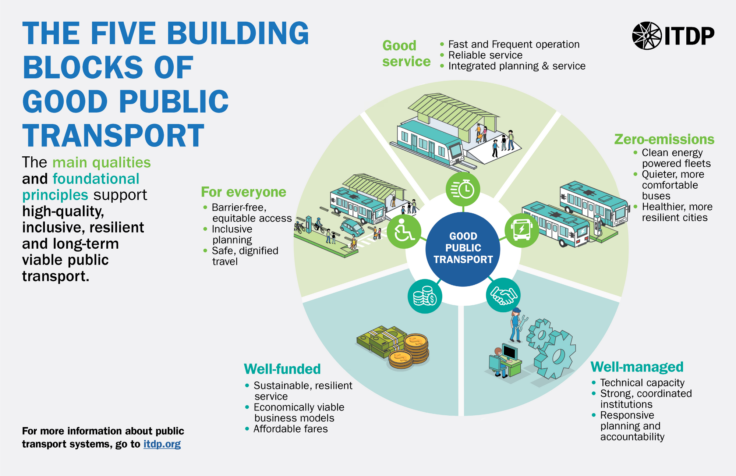
Rather than prescribing a single model, the Building Better Public Transport Systems brief offers a framework of adaptable guidance rooted in decades of global and regional experience. It can be used to align policies, coordinate stakeholders, and establish consistent benchmarks for what constitutes ‘good public transport.’ At a time when cities face growing pressure on their infrastructure, these principles provide a practical, evidence-based path to smarter growth. Regardless of its structure or technology, ITDP asserts that every public transport system must prioritize accessibility, efficiency, safety, integration, sustainability, and sufficient funding.
Public transport sits at the intersection of social, economic, and environmental progress. Strengthening these systems is not only about improving commutes. It is about making cities more resilient, inclusive, and climate ready. When public transport works well, it expands opportunities. It allows communities of all income levels to access employment, education, and healthcare. It supports local businesses by increasing foot traffic and reducing urban inequality by connecting underserved areas.
When it is neglected, the opposite happens. Inefficient and unreliable transport limits access, deepens inequality, and increases dependence on private vehicles. These outcomes place additional burdens on city budgets, air quality, and public health. In the years ahead, amid a worsening climate crisis, cities will need to rethink how they plan, fund, and manage public transport. Successful, forward-thinking cities need public transport that benefits all people. Achieving this will depend on effective governance, long-term investment, and the capacity to adapt to changing urban and environmental conditions.
Subscribe to ITDP’s newsletter for more articles that explore the qualities of good public transport and how cities can improve service and reliability with clear principles.