
August 18, 2025
Rethinking Transport Infrastructure Investments Through the Lens of ‘Bikenomics’
A version of this article, authored by the Dutch Cycling Embassy’s Chris Bruntlett, was originally published in the Austrian Journal for Transportation Science (Issue 01/2025).
Learn more about the Dutch Cycling Embassy’s expertise and programs.
It is no secret that countries in Europe and around the world are facing a period of economic uncertainty. Growing demands for defense spending, customs tariffs, and replacement of post-war infrastructure at the end of its lifespan are putting new strains on national budgets and forcing many governments to rethink their priorities in the face of potential economic recessions. Suppose there is a silver lining to this dark cloud on the horizon. In that case, these governments might also reconsider their transport infrastructure investments, finally taking into account the actual cost to society, from construction to demolition.
These types of societal ‘cost-benefit analyses’ are now quite common in countries like the Netherlands, as the national government legally requires them for infrastructure projects with a specific budgetary value. By quantifying the benefits of getting people out of their cars and onto more active, sustainable, and efficient means of mobility, they have become a game-changer when it comes to reallocating public funds from auto-focused infrastructure to those that encourage more walking, cycling, and public transport. This emerging field has been dubbed ‘bikenomics’ and is responsible for some eye-catching projects in recent years, including parking facilities, rental schemes, and super-highways.
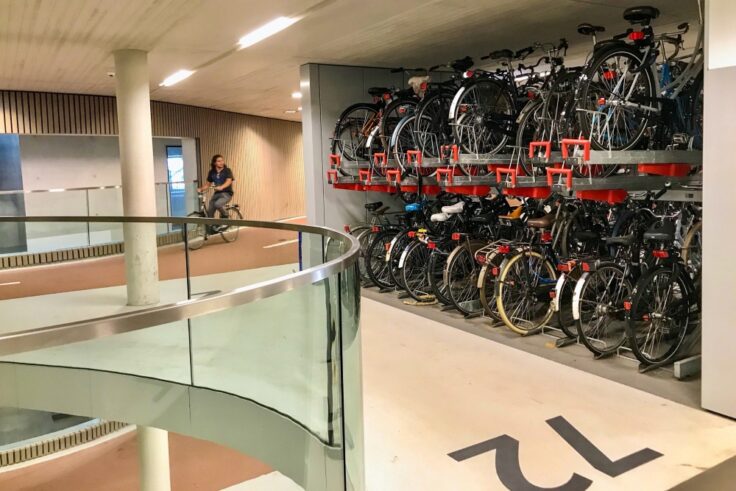
For example, when the city of Utrecht cut the ribbon on the world’s largest (bi)cycle parking structure, with a total of 12,500 spaces spanning four stories underneath its central railway station in 2019, critics called the EUR €30-million price tag “crazy”. But when the municipality applied a bikenomics lens to the ambitious project, they found the societal benefits far outweighed the costs and easily justified the contentious decision to reallocate much of the budget from a proposed multi-story car parking structure elsewhere in the city.
To begin, this external analysis estimated the cost of the parking facility (including amortization, maintenance, and operation) at around one euro per user per day, whereas the cost of providing bus or tram travel was around three euros per user per day. As a result, enabling cycling to the train station saved them millions in public transport subsidies each year. The savings were even more dramatic when compared to accommodating the equivalent amount of car travel to the station. The related negative externalities—such as traffic congestion, air and noise pollution, road safety, and public health—were calculated to cost society tens of millions of euros each year, even in the most optimistic scenarios.
Furthermore, it is widely acknowledged that a significant portion of traffic congestion can be alleviated by replacing a small percentage of cars with alternative modes of transportation. The provision of cycling and public transport supports this shift, allowing authorities to postpone or even supersede road expansions—such as widenings and flyovers—that would cost them billions of euros. By executing this type of analysis and considering the full economic impact of alternative scenarios, including doing nothing, cities like Utrecht can justify ‘extravagant’ infrastructure investments, because they know it saves taxpayer money year after year.
A similar analysis was done to justify Dutch railways’ investment in OV-fiets (shared public bicycles) as a last-mile solution for its passengers. With over 22,500 bikes available to rent at 300 train stations across the Netherlands, the OV-fiets has been dubbed a ‘blue and yellow miracle’ for sustainable, accessible mobility. In fact, in a 2011 survey, 54% of OV-fiets users reported that they use the train more often due to its availability. Eight percent of respondents admitted that, without the bikeshare, they would drive a car door-to-door instead of using it as part of a multimodal bike–train trip. In 2024, researchers at Delft Technical University concluded that every euro invested in OV-fiets returns up to EUR €2.40 in societal benefits, including improved accessibility, reduced congestion, and enhanced health and safety outcomes, all by inducing more transit ridership, more cycling, and less driving.
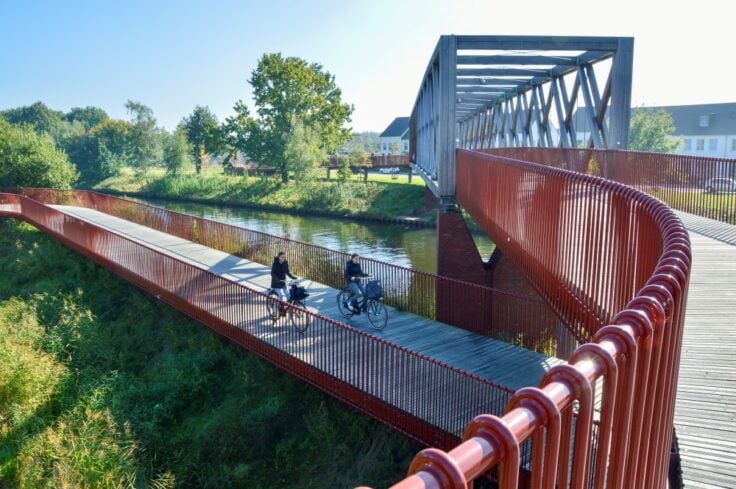
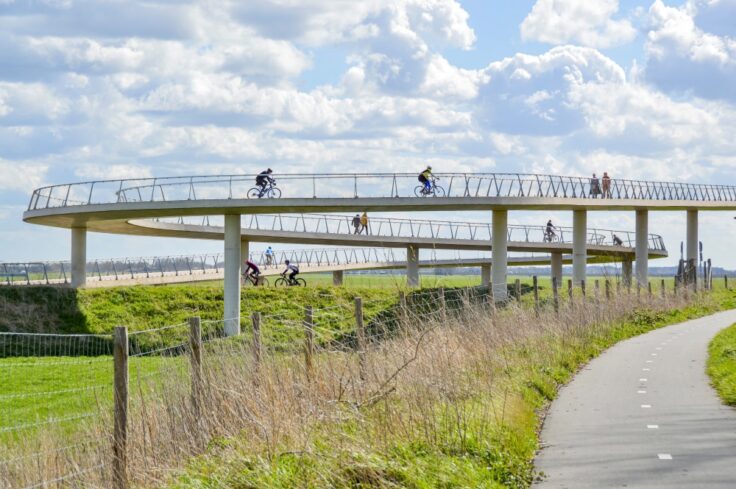
Looking ahead, the next frontier of bike infrastructure in the Netherlands is the development of doorfietsroutes; continuous cycling routes enabled by the extended range of e-bikes designed to cater to trips of 5-15 kilometers, which cause the most significant traffic problems because they are too short for the train and too long for the bus or bike. As a result, regions across the country are investing millions to connect residential, commercial, and educational hubs with direct and comfortable cycle paths, which often require bridges and tunnels to minimize the number of stops.
Early studies have shown these ‘cycle highways’ create a positive shift in travel behavior, with a 10% increase in biking probability for adjacent trips. Considering public health, travel times, road safety and maintenance, noise and air pollution, and tourism, each euro invested is found to return EUR €8.90 in societal benefits. In one specific case, officials who were skeptical of a EUR €15 million cycling bridge across the Maas River as part of a 12-kilometer-long doorfietsroute eventually commissioned a cost-benefit analysis in 2020. It was predicted to save EUR €114 million over its lifetime.
The Dutch’s substantial investment in cycling may seem extravagant to other governments. Still, it is justified, as each penny can be an investment into a healthier and happier population, a low-congestion and low-maintenance road network, and a public realm where people want to spend time and money. This approach goes beyond ‘prestige projects’. It involves building cohesive networks of high-quality cycling routes, reducing the speed and volume of cars traveling through the city, and integrating cycling with public transport.
It is a shift in perspective from asking whether we can afford to invest in cycling, to asking whether we can afford not to, when we consider the full cost of our mobility choices. As populations continue to grow and regions become denser, the need to maintain and create livable, healthy, and happy environments is becoming increasingly critical. Transport plays a crucial role, and cycling can have a profound impact, driving positive change in social, environmental, and economic aspects.
About the Dutch Cycling Embassy
The Dutch Cycling Embassy, as partners in ITDP’s Cycling Cities campaign, is a foundation that has been promoting “Cycling for Everyone, Everywhere” for over a decade. The organization achieves this by sharing knowledge, information, and inspiration via social media, in-person study visits, and ThinkBike workshops, as well as by attending and speaking at international cycling-related conferences.
The Dutch Cycling Embassy represents a collective of public-private organizations, all based in the Netherlands, each playing a key role within the Dutch cycling ecosystem. The Dutch Cycling Embassy serves as the connecting link between cycling-related expertise and experiences in the region and the growing international demand for sustainable mobility solutions.