
April 01, 2026
How Vehicle Size Impacts Our Climate, Health, and Economy
In recent years, SUVs and other large passenger vehicles have become one of the fastest-growing sources of global greenhouse gas (GHG) emissions.
Reducing demand for private vehicles trips and promoting electric public transport is key to ITDP’s vision for the future.
This rise of large vehicles has been so significant that, according to the IEA, if SUVs were a collective country, they would rank among the top five CO2 emitters in the world. Heavier, less efficient, and increasingly dominant in new vehicle markets, these types of vehicles consume more fuel, require larger batteries if electric, and contribute disproportionately to rising energy demand. As large vehicles’ share of global car sales now account for 48% (2023), the trend is coming at a cost to our economies, our public health, and our air quality.
A Milestone Research Report
 Now, a new report from ITDP and the University of California, Davis, supported by the FIA Foundation, takes a closer look at this challenge and offers solutions for addressing it. Compact Cities Electrified: The Benefits of Small Vehicles provides a first-of-its-kind global and country-level analysis of how growing vehicle sizes are shaping urban passenger transport. Focusing in on Brazil, China, India, Indonesia, Mexico, and the United States, the study explores what different policy choices could mean for road safety, energy use, battery demand, and greenhouse gas emissions through 2050.
The research models five plausible futures: a Business-as-Usual scenario, alongside alternatives centered on Mode Shift, High Electric Vehicle (EV) adoption, Small Vehicles, and a combined pathway integrating all three strategies. Across all countries studied, the findings are clear: the sizing of vehicles matter and limiting large vehicles can unlock wide-ranging benefits.
This research methodology builds on ITDP and UC Davis’ previous Compact Cities Electrified reports that found that the only way to prevent the worst effects of climate change – and to harness significant economic savings – is to promote compact, mixed-use cities built around walking, cycling, and public transit, combined with investments in electric transport. More on that research can be found here.
Less Fuel, Cleaner Air and Safer Streets
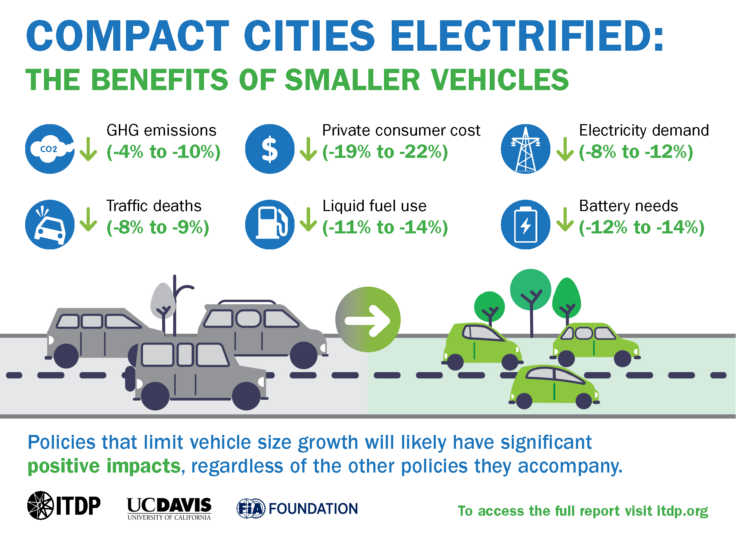
Even on its own, limiting vehicle size (the Small Vehicles scenario) can deliver meaningful results. Capping the growth of larger vehicles can reduce private-sector direct costs by a fifth (19%-22%), with reductions for consumers as well, including lowering costs for vehicle purchases, maintenance, and fuel by 2050. The analysis also found significant reductions in liquid fuel demand by up to 14%; electricity consumption by up to 12%; battery requirements for EVs up to 14%; and reductions in GHG between 4%-10%. What’s more, smaller vehicles are also inherently safer, reducing the severity of crashes and reducing road fatalities by up to 9%.
But the most transformative impacts come from combining multiple scenarios. In the regions studied, polices that integrate Mode Shift, High EVs, and Small Vehicles could, by 2050, reduce transport energy demand by 70%, cut liquid fuel demand by 85%, halve consumer costs, and reduce GHG emissions by more than two-thirds. This combined pathway not only accelerates decarbonization but also avoids the steep increases in energy and infrastructure demand associated with a continued shift toward larger, heavier vehicles – an urgent need as energy volatility continues to be top-of-mind for people around the world.
The research further highlights the critical role of Mode Shift drawing on the previous ‘compact cities electrified’ models (expanding access and ridership across urban public transport, walking, and cycling) as a foundation for a future of more sustainable, livable cities. By 2050, Mode Shift alone could save up to 1.5 million lives and reduce annual road deaths by 40%. When paired with electrification, it significantly lowers air pollution, including fine particulate matter (PM2.5), improving public health and quality of life for people worldwide.
Making the Economic Case
The economics behind this transition is just as compelling as the environmental and health benefits. Fuel costs represent a major and often volatile expense for households and governments alike, particularly in rapidly growing economies. Shifting to electric vehicles – especially smaller, more efficient models – can significantly reduce reliance on imported fossil fuels and shield consumers from price fluctuations. Electricity is generally cheaper and more stable in price than gasoline or diesel, and smaller EVs require less energy to operate, further lowering costs. These savings add up quickly: reduced fuel expenditures, combined with lower maintenance costs for EVs, can ease household transport costs as well as that of local governments in the long run.
Economically, the findings challenge the assumption that cleaner transport must come at a higher cost. In contrast to a Business-as-Usual scenario, where rising vehicle sizes drive up both public and private expenses, the integrated policy approaches outlined in the report mark clear economic benefits. At a time of volatile fuel prices and growing fiscal constraints, this offers a compelling case for governments to rethink investment priorities when it comes to transport infrastructure.
Learn more about the impacts of mode shift and electrification on issues like air quality and health.
A Better Way Forward
Governments and cities have multiple pathways to improve urban mobility systems, but the greatest benefits come from implementing integrated and systemic policies that simultaneously promote public transport and active mobility, accelerate vehicle electrification, and limit the growth of vehicle sizes. Rapid electrification would also be easier and more affordable by reducing the materials, infrastructure, and investment required when combined with size limits and modal shifts.
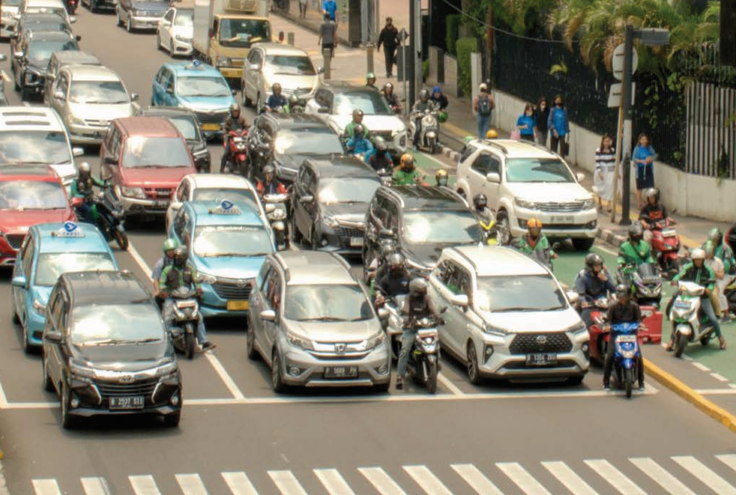
Without these targeted policy interventions, however, the research warns that the current trajectory – marked by rising car use, more SUVs, and growing fuel demand – could lock cities into a future of high costs, greater pollution, and increased road fatalities. By identifying vehicle size as an actionable policy lever, ITDP and UC Davis are providing a landmark roadmap for stakeholders seeking to build cleaner, safer, and more equitable cities in the long-term.