
January 29, 2026
What Cities Can Learn from the Africa Region’s First Electric BRT
A version of this article was originally published in the No. 37 issue of the Sustainable Transport Magazine.
By Dana Yanocha and Alphonse Tam (ITDP Global)
To meet global climate goals, ITDP research shows that cities must both reduce vehicle trips and electrify the remaining vehicles. Electrification discussions often focus on private cars, which dominate trips in high-income countries. In low- and middle-income countries (LMICs), however, most trips occur on public transport and two-wheelers — segments that have received less attention. Electrifying public buses is a key strategy to decarbonize urban transport, reduce vehicle numbers, and improve efficiency. Yet high upfront costs and infrastructure challenges have continued to slow down adoption across LMICs.
Why Electrify?
Public transport electrification is a vital pathway for cities to meet urban development goals — from reducing emissions to improving air quality to driving economic growth. While private vehicles are the largest source of greenhouse gas (GHG) emissions, diesel buses also contribute significantly. Electric buses have already been shown to help cut GHG emissions by 48% in Shenzhen, China; 65% in Mexico; and up to 78% in Colombia. Diesel buses are also major sources of local air pollutants like nitrogen oxides (NOx) and particulate matter (PM), which harm public health.
E-buses nearly eliminate these emissions and further reduce noise pollution, another emerging concern for mental and physical well-being. E-buses also bring modern operational tools such as automatic vehicle location systems and digital fare payments, which help improve reliability, integration, and convenience. These technologies, along with new business models like asset leasing, can help attract more private investment into e-buses and share the upfront costs between the public and private sectors.
Learn more about ITDP’s strategic vision to increase public transport ridership and electrify transport systems.
At the national level, e-buses can reduce dependence on fossil fuel imports, ease pressure on foreign currency reserves, and improve economic stability, especially in countries that rely heavily on imported fuels. Electrification makes public transport more attractive and equitable by replacing aging fleets and formalizing informal systems with safer and more comfortable vehicles. Higher-quality service thus encourages more people to use bus networks, expanding access to jobs, schools, and essential services.
Surveys in cities such as Santiago, Chile, Bogotá, Colombia, and Pune, India, show higher passenger satisfaction with e-buses, while drivers report safer and more comfortable work shifts due to reduced exposure to exhaust and heat. The transition to e-buses represents the future of urban mobility — cleaner, quieter, and more equitable — and one city in Africa is already demonstrating this transformative potential to the world.
Dakar’s e-BRT Lights the Way
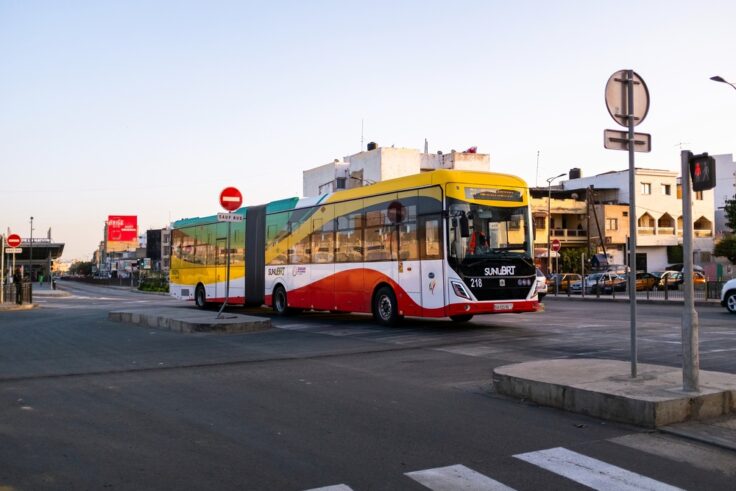
In 2025, Dakar, Senegal, commenced full operations for the region’s first all-electric bus rapid transit (BRT) corridor. The 18-kilometer, 23-station, center-running BRT operates along the city’s north-south axis with over 120 e-buses. The project’s inception to implementation and launch took more than 20 years, beginning in 2002 when the U.S. development agency USAID provided funding for sustainable transport projects in Senegal, Ghana, and South Africa.
The Dakar region’s transport authority, CETUD, first proposed a BRT system, drawing inspiration from Bogotá, Colombia’s Transmilenio BRT and a ‘South-South exchange’ visit between the former mayor of Bogotá and Dakar. The then-President of Senegal, Abdoulaye Wade, and local decision-makers displayed a strong interest in facilitating a mobility transformation in Dakar with a BRT that better serves the rapidly growing population.
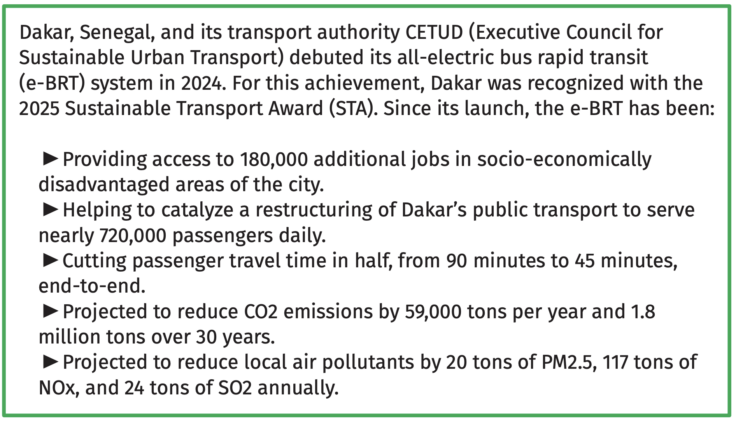
For its innovative e-BRT, Dakar and CETUD received the 2025 Sustainable Transport Award.
Throughout the initial planning processes and evaluations, e-buses emerged as a viable option for the BRT to reduce fuel imports and, crucially, address mounting air quality concerns. One hundred percent of Dakar’s population was found to be exposed to harmful PM levels in the air, which exceeded the national limit. Road traffic pollution also accounted for nearly 7% of deaths in Dakar, resulting in estimated costs of more than USD $687 million.
Low-interest concession loans from the World Bank’s International Development Association (IDA) and European Investment Bank covered the infrastructure (lanes, stations, depots); e-buses were purchased and operated by Meridiam, a private sector investor; and the IDA and national government supported land acquisition. Crucially, the IDA provided viability gap funding to cover the difference in capital costs between diesel and e-buses, successfully reducing some financial risk for the private sector.
Dakar’s urban transport sector previously relied primarily on loosely regulated paratransit service providers. CETUD emphasized the need to formally incorporate these operators into the BRT network as feeder lines and to integrate the BRT with the city’s existing commuter rail to ensure a cohesive citywide transport network. In 2017, the e-BRT project secured financing, leveraging a new business model that balances financial and operational risk across the national government, public investors (development banks), and the private sector.
Watch Dakar’s 2025 STA Ceremony here, and download their STA Spotlight report.
Learning from Dakar’s Experience
Since debuting in 2024, Dakar’s e-BRT system has become a model for global cities to learn from. Three key takeaways from Dakar and CETUD’s experience can help others streamline decision-making and ensure new e-BRT projects are implemented in shorter timeframes. First, it is crucial to make the case for e-BRT. While these systems deliver critical decarbonization benefits, this may not be the best or only entry point to make the case. Governments are increasingly concerned with air pollution while also focusing on economic growth and energy security.
Framing e-BRT as a strategy to also improve outcomes in these areas can widen the base of support. In Dakar, mounting public health costs related to air pollution were a major factor in the decision to use e-buses. It is also essential to consolidate negotiating and decision-making processes. Governments interested in pursuing e-BRT must have a clear understanding of financing and contract negotiation, including risk allocation and procurement. Working within a public-private partnership structure is complex, requiring collaboration amongst different stakeholders and a clear decision-making authority. It is beneficial to consolidate some of this responsibility at the national level, where capacity and resources are likely to be more robust.
Leveraging new business models is essential as well. Electrification as a climate strategy is gaining attention from climate investors and financiers, especially as renewable energy reaches market maturity. This opens the door for governments to evaluate different business models to deliver e-BRT and other bus projects, leveraging private investment where it had not been available before. Private investor Meridiam recognized the revenue potential in purchasing e-buses and operating Dakar’s BRT, leveraging digital tools that enable transparency and accuracy in revenue generation.
“[The e-BRT’s] fully electric vehicles, solar-powered bus stations, and smart systems align with global sustainability trends, making Dakar a green leader and model for Africa,” said former Director General of CETUD, Dr. Thierno Birahim AW, when accepting the 2025 STA.
“All these advancements enable us to offer a high-quality, efficient public transport alternative to private cars for everyone.”