
October 10, 2025
Lessons from Jinan, China’s Electric Transformation
In recent years, China has emerged as a global leader in public transport electrification.
From megacities like Shenzhen and Beijing to provincial capitals, the rapid expansion of electric bus fleets has dramatically reduced carbon emissions and accelerated progress toward sustainable urban mobility. Among these success stories, Jinan’s dual-source trolleybus project, planned with the support of ITDP China, stands out as a model for green transformation — not just in China, but for the entire region.
Home to over nine million residents, Jinan is the capital of Shandong Province and has long struggled with traffic congestion and air pollution. Rather than relying on short-term congestion control, in 2016 the city initiated a bold, forward-looking strategy to make electric public transport a cornerstone of its urban mobility and infrastructure development.
Read a version of this article in Chinese on ITDP China’s WeChat channel.
Jinan launched its landmark trolleybus demonstration project supported by a USD $336 million loan from the Asian Development Bank (ADB). From the outset, ITDP China worked closely with the municipal government and ADB to plan and design the project, helping evolve it from a simple fleet renewal into a system-wide transformation that integrates comprehensive transport policy, technology, and network design.
Jinan’s Keys to Success
Policy Coordination: Making Green Transport Systematic
Unlike many vehicle replacement programs, Jinan’s project embedded electrification within a broader urban framework. The city aligned the trolleybus system with low-emission zone (LEZ) policies, walking and cycling networks, and bus service optimization, ensuring that green mobility was supported by cohesive urban planning. With ITDP China’s technical assistance, the project adopted a systemic approach that improved operational efficiency and policy coherence.
Technological Innovation: Dual-Source Power to Overcome ‘Range Anxiety’
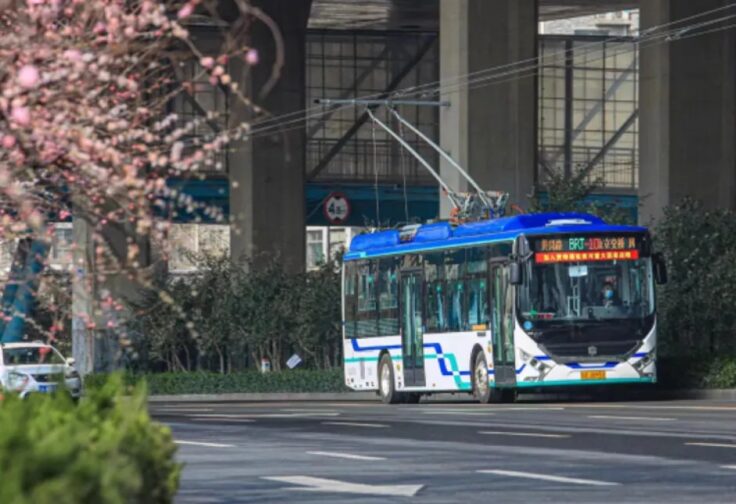
Jinan’s dual-source trolleybuses can draw power from overhead lines and switch seamlessly to on-board batteries when operating off-line. This hybrid design eliminates the risk of ‘range anxiety,’ while reducing operational costs and improving route flexibility. The model has since become a benchmark for trolleybus modernization in China and beyond.
Network Integration: Linking BRT and Trolleybus Systems
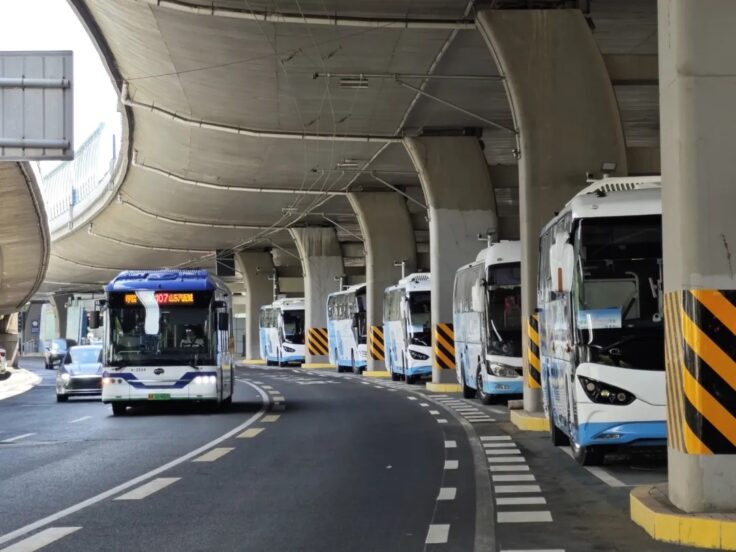
Integration has been a defining feature of the project. The new trolleybus corridors are fully connected to Jinan’s existing Bus Rapid Transit (BRT) network, which is one of the earliest BRT systems in China. This connection streamlines passenger transfers, improves travel times, and enhances the overall efficiency of the bus network.
Tangible Results
The scope and outcomes of the project have been inspirational:
- Six dual-source trolleybus lines launched
- 80 kilometers of BRT corridors constructed
- 350 dual-source trolleybuses and 800+ pure electric buses deployed
- 75.1 kilometers of power lines and 32 substations completed
- Suncun Comprehensive Station, China’s largest bus maintenance base, built
- 128 smart bus platforms upgraded with real-time passenger information
These achievements have already delivered measurable environmental impact. The project is expected to reduce annual CO2 emissions by 62,000 tons while, in 2023, over 75% of all trips in Jinan were made with green modes such as public transit, cycling, and walking. The initiative has received wide recognition, including earning ADB’s Best Performing Loan Project of 2023 honor.
Lighting the Way for Other Cities
Jinan’s experience demonstrates that urban transport electrification is most effective when pursued as a system-wide reform that highlights public transport alongside other forms of mobility improvement. Through coordinated policies, innovative technologies, and integrated networks, cities can achieve meaningful reductions in emissions while improving accessibility and livability.
ITDP China’s technical expertise and local engagement helped develop a replicable ‘Jinan model,’ offering valuable lessons for Chinese cities, and for large cities worldwide, that are seeking to accelerate their electric mobility transitions. Jinan’s transformation shows that sustainable transport is not achieved through technology alone, but through connected planning, cross-sector collaboration, and strong policy commitments.
As global cities move towards decarbonization, Jinan provides a compelling blueprint for how integrated, people-centered planning can deliver on cleaner air and more public transport ridership.