
May 07, 2026
A Reimagined Transport Hub Takes Shape in Mexico City
The ongoing evolution of Buenavista Station in Mexico City illustrates how investment in multimodal hubs can reshape urban mobility — and why the next phase of its transformation could be even more significant.
Read a version of this article in Spanish from ITDP Mexico.
Once a historic rail terminal symbolizing the city’s modern development, Buenavista now stands at the center of a new opportunity to strengthen public transport and reduce car dependency across a congested Mexico City. Originally inaugurated in the 19th century as the country’s main gateway, Buenavista declined alongside Mexico’s passenger rail system in the late 20th century as private vehicles became more and more dominant.
Its revival began in the last few decades started with the introduction of the Tren Suburbano, a suburban rail line reconnecting the capital city center with surrounding municipalities through dedicated and reliable public transport service. Since then, the station has regained ground as one of the city’s most important mobility nodes, linking suburban rail to the Mexico City Metro and Metrobús systems, as well as extensive cycling infrastructure, pedestrian networks, and commercial areas
Yet despite this high level of connectivity, Buenavista’s full potential as an active, modern, and people-centered transport hub remains unrealized. This is beginning to change with a major new development — the extension of the suburban rail line to the new Felipe Ángeles International Airport (AIFA) in 2026. This extension will redefine the station’s role within the metropolitan region for everyday commuters as well as tourism. The extended line, recently inagurated by Mexico’s President Sheinbaum in 2026, will directly connect Buenavista to the airport which itself debuted in 2022. This connection aims to significantly reduce travel times and offer a viable public transit alternative to private vehicles and taxi/rideshare trips to AIFA.
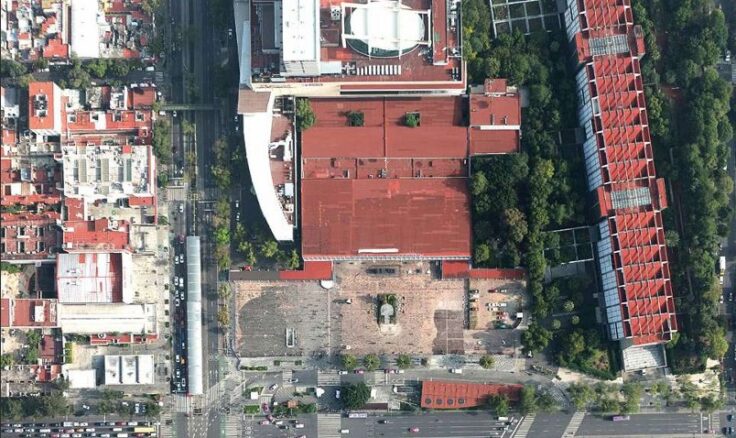
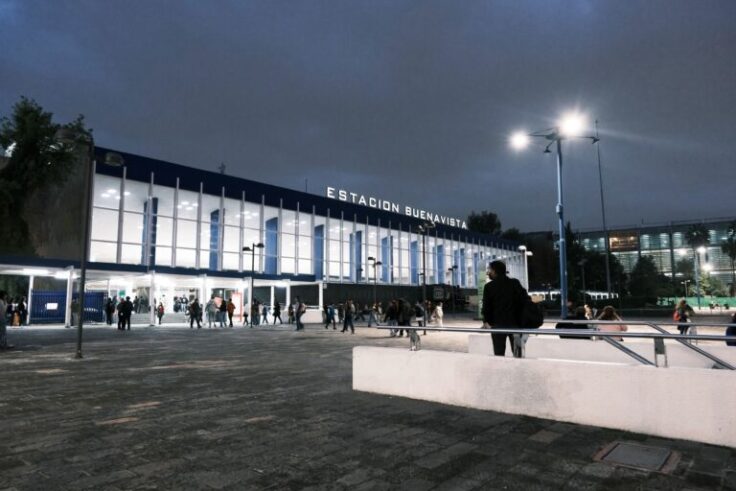
An aerial view and night view of the existing Buenvista Station, which has historic significance as a mobility hub for the city.
This new connection represents more than just a new route. It signals a shift toward a more integrated transport system, particularly with the inclusion of the city’s unified fare system, the Integrated Mobility Card, which will improve and ease access for riders across the city’s transit systems. By enabling users to move easily between rail, metro, and bus modes without friction, the integration simplifies journeys and enhances the overall public transport experience. These digital and interoperability measures are vital for building a cohesive mobility system and alternative to unnecessary vehicle trips
For ITDP Mexico, which has been collaborating for years with public-private stakeholders on a Buenavista revitalization plan, the expansion to AIFA offers a critical moment for change. Buenavista is already one of the most densely connected transport nodes in the city. Still, increased passenger volumes from the airport link will put even more pressure on its infrastructure, circulation, and public space. Without intervention, this growth could lead to more congestion, confusion, unsafe roads, and diminished transit experience. With the right planning and vision, however, it could instead catalyze much-needed transformation in and around the Buenavista area.
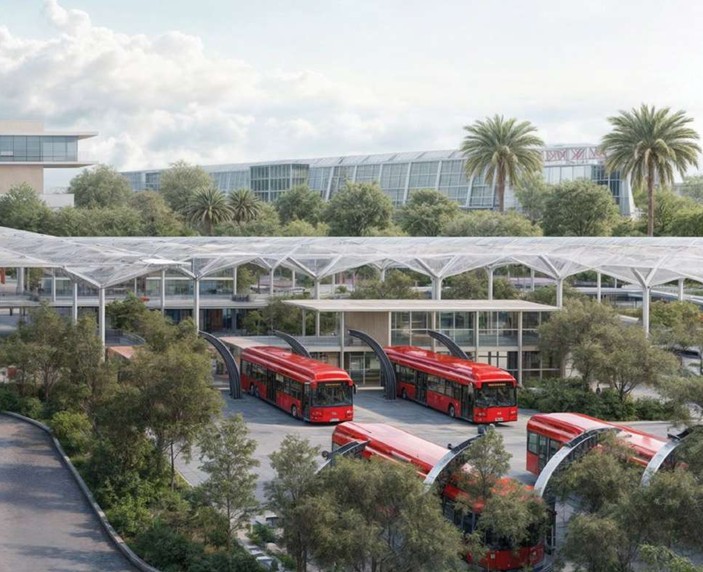
To seize upon moment, ITDP Mexico, in collaboration with several key funders and partners, released the Buenavista Central Station proposal — a comprehensive vision to consolidate the station as a true modern metropolitan mobility hub. The proposal focuses on integrating multiple systems more effectively, ensuring that transfers and access between the suburban train, metro, public buses, and cycling are made more intuitive, safer, and reliable. The proposal emphasizes universal accessibility, clearer wayfinding, and improved station and corridor design to accommodate all types of users based on the principles of transit-oriented development.
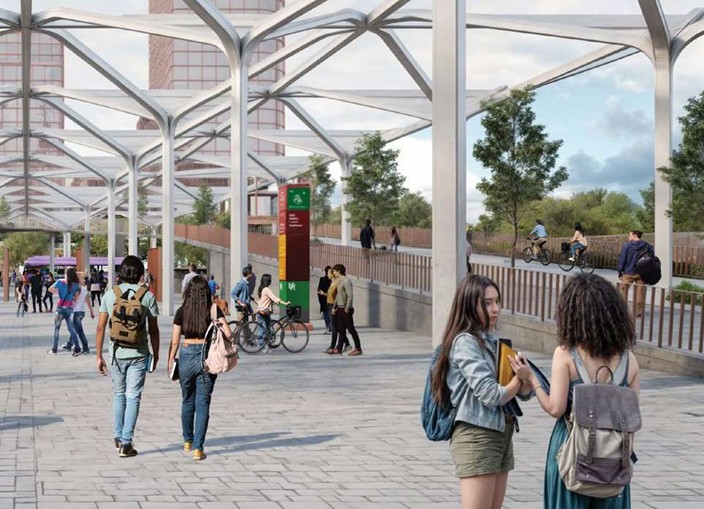
Renderings of improved pedestrian circulation and bus connections within the Buenavista Station proposal.
Read why ITDP is committed to increasing public transport ridership across our key regions.
Equally important is the proposal’s focus on the surrounding urban environment. By incorporating public space improvements, environmental planning, and sustainable development principles, the proposed plan aims to transform Buenavista into more than a transit point. It envisions a vibrant, people-centered space that supports both mobility and urban life, benefiting commuters and residents alike and fostering urban resilience. This is particularly key for the surrounding areas where commercial, academic, and residential nodes are continuing to expand.
The stakes for this revitalization are high. Strengthening Buenavista as a central station could significantly reduce reliance on private cars for airport trips, cutting emissions, easing congestion, and improving road safety. More broadly, it aligns with long-term goals for sustainability and equity, ensuring that efficient, affordable transport is accessible to a wider population. Ultimately, the redevelopment of Buenavista — and its future connections to AIFA and beyond — demonstrates how transport infrastructure planning needs to take a comprehensive view of a city’s needs. When paired with thoughtful designs, responsive planning, and targeted investment, they can help reshape the entire area’s future.
Buenavista offers a compelling example that committing to well-designed transport hubs is not just about moving people around, it is about uniting the past, present, and future of a city’s mobility system.