
April 07, 2026
Managing the Challenges of China’s E-Bike Boom
A version of this article was originally published in the No. 37 issue of the Sustainable Transport Magazine.
By Qianqian Hu and Qiuyang Lu, ITDP China
In recent years, e-bikes have continued to experience explosive growth in cities across China, driven by the demand for affordable, sustainable, and flexible mobility. Yet this rapid rise has far outpaced the development of effective regulations or supporting infrastructure, leading to widespread challenges, especially in parking. Many municipal governments continue to grapple with how to confront these pressures with actionable policies. Against this backdrop, some major Chinese cities are beginning to take proactive steps. Lessons from Beijing and Guangzhou demonstrate how innovative and scalable strategies can be adopted to manage e-bike usage, particularly with storage, to complement public transport and sustainable mobility as a whole.
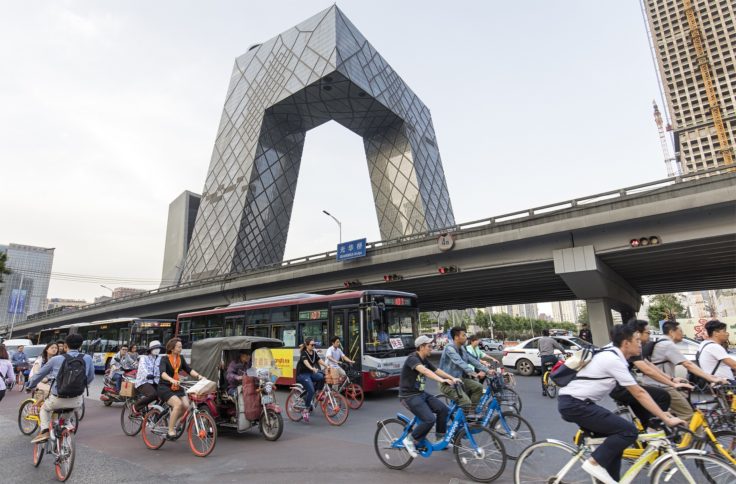
A New Parking Strategy for Beijing
Beijing, a city of over 20 million residents, is also home to more than 7 million e-bikes — and that number is growing by over a million every year. These e-bikes have become an essential mode of transport for daily commutes, connecting bus and metro routes, goods deliveries, and short-distance trips. However, their explosive growth has significantly outpaced the city’s available parking infrastructure, particularly in areas around offices, transit stations, and shopping centers. This unique challenge has spurred the city to explore innovative solutions.
According to ITDP China’s on-the-ground research, for example, a 200-meter road near a commercial transit hub in Beijing can have up to 400 two-wheeled vehicles parked. More than a third of them are e-bikes, and many others are just abandoned vehicles. Because of the lack of well-planned and clearly marked parking facilities, these vehicles are often left blocking sidewalks, cycling lanes, and other public areas, creating significant challenges for mobility and public spaces.
In response to the parking crisis, Beijing officials have implemented top-down solutions focused on maximizing existing spaces and creating new, dedicated storage facilities. These strategies are tailored to high-demand locations, aiming to strike a balance between efficiency and user convenience. For each area, officials conducted research into travel patterns and parking needs to identify the specific gap between supply and demand. This data-driven analysis was instrumental in informing a comprehensive e-bike action plan, which encompasses parking expansion, categorized parking guidance, and long-term management tools.
One of the strategies employed was the repurposing of existing urban spaces. Underutilized public areas — such as corner street plots, green spaces, car parking, and even spaces beneath overpasses — are now being converted into designated e-bike parking zones. To ensure these new facilities are used properly, directional signage to properly guide users is also being designed. Furthermore, during peak hours, residents and volunteers from community organizations provide on-site support to ensure orderly and safe use of these spaces.
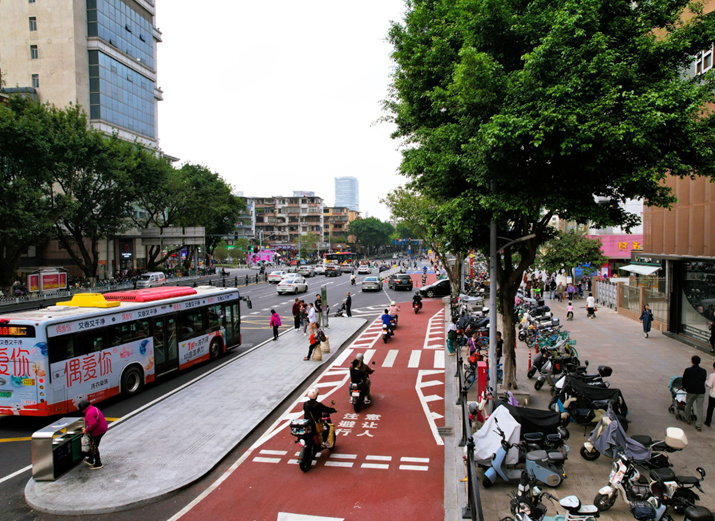
At the same time, the city is also exploring technology-based solutions and opportunities for infrastructure improvements. Beijing’s new approach to e-bike management can be seen in places like the Shahe Subway Station, which handles nearly 100,000 passenger trips daily. The city is not only repurposing unused space around the station for parking, but it is also testing geo-fencing technology for shared bikes and e-bikes to encourage riders to end their trips in designated parking areas. For personal e-bikes, facilities are further equipped with sheds, charging plugs, and fire protection.
In addition to managing almost 10,000 bikes and e-bikes parked at Shahe Station each day, a three-floor bike-specific parking garage is under construction. This facility will not only provide much needed storage but will also offer comprehensive services to riders, including stores, bike repair shops, and safe charging stations. The city is also developing a series of standards to define similar parking facility types with requirements for better planning, design, construction, fire protection, and maintenance. Beijing’s strategies provide a broad framework for guiding the long-term management of e-bikes. It is also a testament to the city’s commitment to improving oversight, charging infrastructure, and parking so that millions of residents can continue to ride safely and efficiently.
Better Parking and Charging Across Guangzhou
In 2024, citywide daily cycling trips in Guangzhou reached over 9 million — a nearly 9% year-on-year increase and the first time the figure has surpassed the local metro network’s daily ridership. Citywide, registered e-bike ownership has exceeded 5.6 million, with the total vehicles in circulation estimated at over 6 million. This surge underscores two-wheelers’ growing role for short trips and last-mile connections citywide. The boom has, however, strained Guangzhou’s street infrastructure. Metro stations, commercial centers, and office districts face chronic shortages of designated parking, resulting in sidewalk spillover, informal charging, and rising chaos in public spaces.
In early 2025, the city prioritized e-bike governance with a three-pronged strategy to ensure riders have ‘a path to ride, a place to park, and the power to charge’. Crucially, this strategy is complemented by a fast-growing non-motorized transport (NMT) street network that is also making curbside parking more feasible for e-bikes. Between 2022 and 2024, Guangzhou upgraded and connected cycling corridors to form 2,966 kilometers of NMT lanes, reaching an impressive 82% street coverage in six districts.
Watch this ITDP China video highlighting recent progress on cycling infrastructure in Guangzhou.
To understand how these spatial changes translate to day-to-day life, ITDP China carried out a multi-site field study focused on two high-demand typologies for e-bikes and NMT: metro station surroundings and central business districts. This exploration revealed interesting context-based approaches for managing Guangzhou’s surge in e-bikes. One strategy focused on space reallocation and shared oversight around transit stations.
At the busy Sanyuanli and Zhongda Stations, for instance, idle curbside and plaza pockets were converted into designated e-bike parking zones, integrated with the broader cycle lane network. These areas are supervised on-site by security or property staff for daily parking enforcement. In Zhujiang New Town, sidewalk extensions and pocket-park corners were adapted into linear parking bays with signage and soft separators, reducing conflicts with pedestrian routes.
The flexible use of ‘gray space’ was also innovative. At Chigang Station, previously unused under-bridge and underpass spaces were redesigned for e-bike parking. This relieves surface-level pressure and avoids e-bike clashes with pedestrians, particularly near hospitals and transit nodes. To better manage the parking order, paid pilots were also implemented. In especially dense areas like Xilang Station, the city is piloting fee-based, fenced parking in repurposed under-bridge spaces. Monitored by staff and priced modestly, these facilities deter long-term storage and reduce sidewalk overflow.
Guangzhou has also been focused on charging integration where possible. Select high-demand sites — such as a repurposed vehicle parking lot near Zhongda Station — include on-site charging points and cabinets that offer safe, dependable options to plug in. Citywide, however, the charging network remains in early development, with much charging still occurring informally or in residential compounds. These public pilots, however, offer a better path forward.
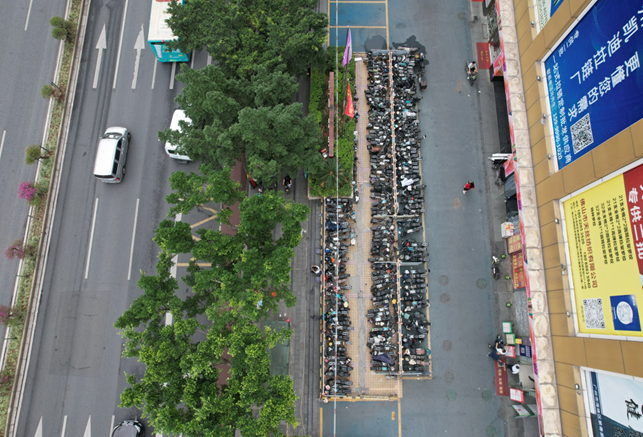
Together, these measures show Guangzhou’s shift toward a contextual approach to e-bike management: rather than one uniform solution, each site is tailored to its own land use, demand profile, and street conditions. The city prioritizes on-site human supervision over technological controls, keeping operations cost-effective in a dense core. At the same time, expanded NMT lanes ensure riders can reach designated zones safely and quickly. These outcomes suggest that a megacity can effectively navigate e-bike growth by combining infrastructure provision with improved operations. This strategy — ‘a path to ride, a place to park, and the power to charge’ — offers practical lessons for other cities.
Together, these parking-related e-bike challenges in Beijing and Guangzhou, along with their respective solutions, offer a roadmap for other areas also experiencing a surge in micromobility. Better oversight and regulations are crucial for harnessing the climate, economic, and social benefits of using e-bikes over private cars for urban trips. Both cities have moved beyond simple patchwork solutions by combining infrastructure demand with flexible, technology-informed strategies. Beijing’s approach showcases top-down planning, while Guangzhou’s highlights the value of localized interventions.
These examples prove that effective, long-term e-bike management requires proactive and mindful planning to meet the diverse needs of all riders.