
December 16, 2025
ITDP Mexico’s Ciclociudades Monitor Assesses Cycling Across Latin America
 Since 2011, Ciclociudades has been a key initiative of ITDP Mexico to measure the progress of cycling mobility across cities — originally focused on Mexico, now expanded to include other countries in Latin America.
The Monitor and its past Rankings have been influential in guiding governments, planners, and civil society in designing and implementing better active mobility infrastructure and policies across the region.
The 2025 Monitor is the first iteration since the 2021 ranking, and offers a pioneering tool designed for measuring and tracking the development of cycling mobility across Latin American cities. Building on ITDP Mexico’s decade of experience evaluating urban cycling nationally, the Monitor expands its scope and ambition by offering a comprehensive framework that now integrates the primary sectors of governments, civil society, and cyclists.
Through a carefully re-designed methodology, the Monitor also provides reliable and comparable data to support evidence-based decision-making and to foster the growth of equitable, sustainable, and more ‘cyclable’ cities across the region. The new Monitor further incorporates participatory mapping, user-perception surveys, and questionnaires from cycling groups in order to center the views of everyday cyclists and advocates as part of data collection and decision-making.
A Tool for Collaboration and Policy Development
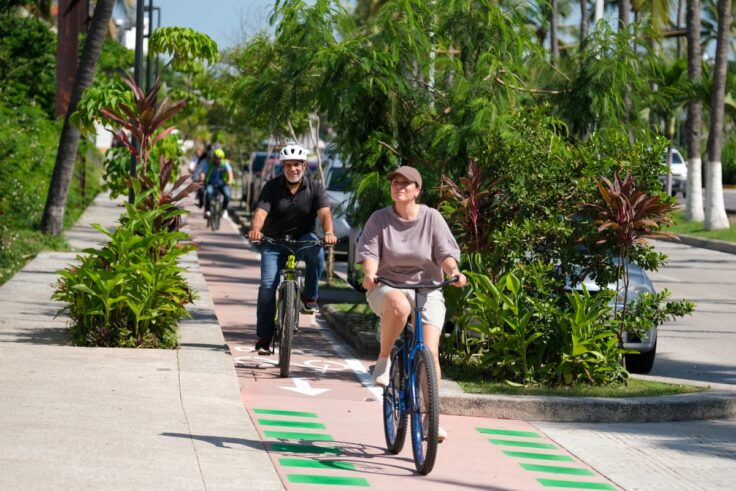
The Monitor brings together the experiences of 26 participating cities and their feedback, organized across the three sectors mentioned. Each segment provides distinct yet complementary perspectives on the state of urban cycling, illustrating how diverse actors contribute to building more cycling-friendly cities. For governments, the Monitor compiles quantitative data using a standardized evaluation form covering infrastructure, education, promotion, monitoring, and governance. This information is used to measure the reach, quality, and institutional strength of cycling policies and facilities. Governments can use these insights to benchmark their progress, identify challenges, and learn from peers across the region.
The second sector highlights the participation of civil society organizations from more than 20 cities, whose responses were collected via a qualitative questionnaire. These inputs reveal how cycling is perceived on the ground by communities and how inclusive, safe, and effective local policies can be created with the perspectives of citizens who rely on cycling. This information is essential to complement official data, providing a complete and more nuanced picture of existing mobility conditions.
Finally, the Monitor includes a section devoted to everyday cyclists. Surveys conducted among users in more than 20 cities, each with at least 40 responses, examine perceptions of safety, comfort, and accessibility. These findings shed light on the everyday realities of cycling and the broader cultural and behavioral shifts needed to make cities more supportive of active mobility. Together, these three segments make the Monitor a dynamic and participatory tool that values institutional awareness as much as citizens’ experience.
Ciclociudades‘ shift from a ranking system to a monitoring platform emphasizes long-term collaboration, encouraging regional actors to see their ongoing efforts as part of a shared journey toward cycling cities. The name change also reflects this shift in vision. Instead of awarding scores, the Monitor seeks to document progress in improving cycling policies while also elevating best practices. The emphasis is now on shared learning and evidence-based decisions, rather than comparative performance. With this approach, ITDP Mexico aims to better guide local government action, strengthen institutional capacities, and build partnerships that bridge the gap between multiple audiences.
Redesigning the Methodology
The Monitor’s structure combines quantitative and qualitative components to provide a holistic picture of cycling mobility in Latin America. The core evaluation form shared with government institutions assesses three principal axes: infrastructure, education/promotion, and monitoring/governance. Within these areas, indicators capture factors such as network coverage and quality, institutional frameworks, communication campaigns, and citizen engagement. Developing the 2025 Monitor involved a four-phase redesign of the methodology to ensure the tool’s robustness, comparability, and relevance at the regional level.
The first phase focused on identifying areas for improvement by examining inconsistencies across earlier editions and proposing a reliable approach to be applied consistently in future updates. The second phase involved interviews with participants from previous years, who provided valuable recommendations, including developing a digital platform, strengthening gender and inclusion perspectives, and adopting a two-year evaluation cycle. In the third phase, ITDP Mexico conducted an international review of global assessment frameworks, including the Copenhagenize Index, Bike Score, and Global Bicycle Cities Index.
Drawing from these models, the team identified best practices and adapted them to the Latin American context through in-depth workshops with mobility experts. Finally, the fourth phase consisted of pilot applications in cities such as Bogotá, Colombia; Buenos Aires, Argentina; Santiago, Chile; Querétaro, Mexico; and Tijuana, Mexico. These pilots were instrumental in simplifying the indicators, refining definitions, and establishing a shared technical glossary. The outcome of this process is a robust, transparent instrument that captures the complexity of cycling in Latin American cities and will hopefully remain a relevant and practical tool for years to come.
Embracing Regional Participation
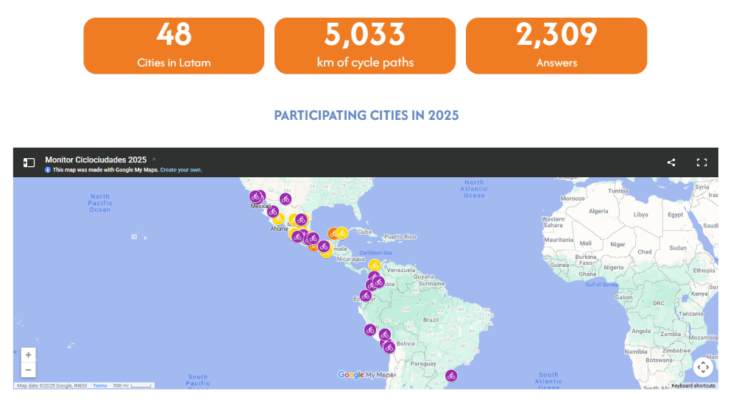
The 2025 Monitor most notable bought together an unprecedented range of cities and participants from across Latin America. On the government side, participants include major cities such as Mexico City; Buenos Aires, Argentina; Santiago, Chile; Cartagena, Colombia; and Guadalajara, Mexico, as well as a diverse array of Mexico’s urban municipalities, including Mérida, Monterrey, Puebla, San Luis Potosí, Oaxaca, and Torreón. Each of these entities contributed detailed information on their infrastructure, policies, and programs, reflecting a growing regional interest and commitment to prioritizing cycling as a component of sustainable mobility systems.
Civil society’s participation is equally diverse, spanning organizations from Argentina, Brazil, Colombia, Mexico, and Peru. From grassroots collectives in Cali and Medellín in Colombia, to advocacy groups in Querétaro and Tijuana, Mexico, and Arequipa and Lima, Peru, these organizations provided crucial local perspectives that grounded the Monitor in real-world experiences. Their engagement not only enriches the data but also underscores the importance of community involvement in shaping bottom-up mobility policies. As cities across Latin America face rising congestion, air pollution, and inequality, the bicycle remains a powerful solution for all. The 2025 Monitor provides the data, partnerships, and frameworks necessary to transform diverse urban environments by helping governments and communities understand their current position and ways to move forward, together.
Watch this launch webinar for the 2025 Monitor hosted by ITDP Mexico.
This collaboration across a spectrum of governments, institutions, and citizens highlights a shared vision: creating more cities where cycling is recognized as safe, accessible, and a primary mode of transport. For more information, visit the Ciclociudades website or contact the team at [email protected].