
September 04, 2026
Putting Transit-Oriented Development into Practice in Indonesia
Rapid urbanization in Indonesia is creating two interconnected challenges.
Limited access to affordable housing and increasing distances between where people live and where they work, study, and access services are straining many cities. Transit-Oriented Development (TOD) offers an opportunity to address both by bringing housing, jobs, services, public space, and sustainable transport closer together. Yet TOD is often reduced to a simple formula: building apartments around a transit station. This narrow interpretation raises an important question: can TOD work in cities with different transport systems, housing markets, and urban forms? The experiences of cities like Jakarta and Semarang suggest that it can, but only if cities adapt TOD principles to local conditions rather than replicate a single model.
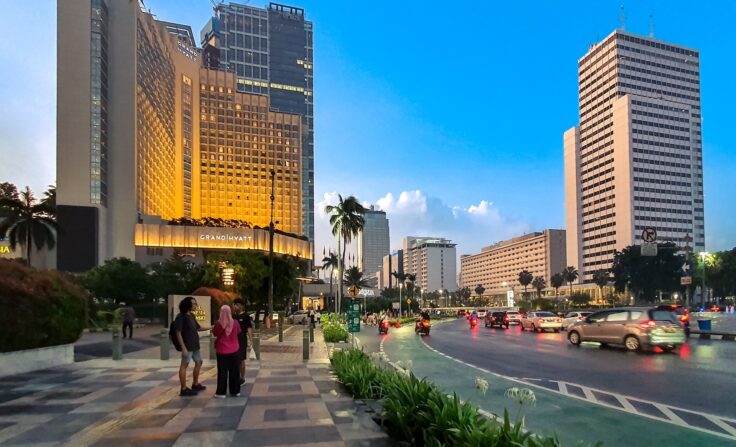
Jakarta as a Laboratory for TOD
TOD aims to integrate people, activities, buildings, and public spaces through convenient access to walking, cycling, and public transport. These principles underpin ITDP’s TOD Standard 3.0 and Indonesia’s national TOD regulations. Jakarta has been among Indonesia’s early leaders in translating these principles into detailed regulations. Five TOD areas have been designated around MRT stations, while the city’s wider public transport network also offers opportunities for TOD around other major nodes. Transjakarta, for example, carries up to 1.4 million passengers a day and connects with multiple transport modes, creating TOD potential beyond rail stations.
However, Jakarta’s experience also highlights the limitations of focusing primarily on transport infrastructure and development around stations. Housing affordability remains a major challenge. Housing prices in Jakarta can reach over ten times the average annual household income, while only around 20% of Indonesian households can afford commercial housing. In the Dukuh Atas TOD area, land and building prices increased by an average of 50.94 percent between 2018 and 2023.
As housing becomes less affordable, TOD risks becoming associated with premium development rather than inclusive neighborhoods. Some developments marketed as “TOD housing” have also focused primarily on proximity to stations without ensuring access to schools, services, public spaces, and other daily needs. This can undermine fundamental TOD principles such as compact development and mixed uses. Jakarta therefore demonstrates that regulations and investment around transport nodes are necessary but insufficient. Effective TOD must also protect housing affordability and improve connectivity across the surrounding neighborhood.
Promoting TOD is key to ITDP’s vision for increasing public transport ridership worldwide.
Adapting TOD to the Semarang Context
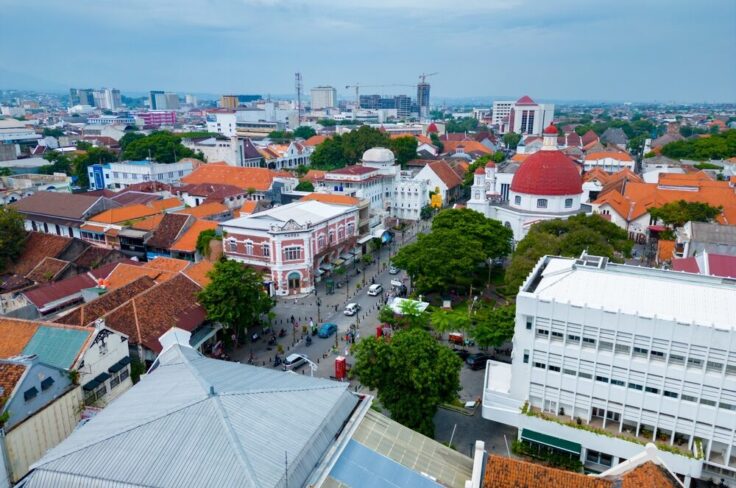
Jakarta’s lessons are particularly relevant as the Central Java Provincial Government promotes TOD in other cities, such as the Kedungsepur metropolitan area. In Semarang, planning includes integrating commuter rail, Trans Jateng, and feeder services at Tawang Station; extending commuter services toward Weleri and Batang; developing new inter-regional bus routes; and electrifying the Trans Jateng fleet. But Semarang Tawang presents a fundamentally different context from Jakarta’s newer, high-density transit developments.
The potential TOD area extends up to 800 meters from the station and includes Semarang Old Town, established neighborhoods, and warehouse areas supporting Tanjung Mas Port. Its heritage character means TOD cannot be based solely on new construction or increased density. Instead, it must strengthen connections within the existing urban fabric while protecting the identity and affordability of surrounding communities. Connectivity remains a major challenge, however.
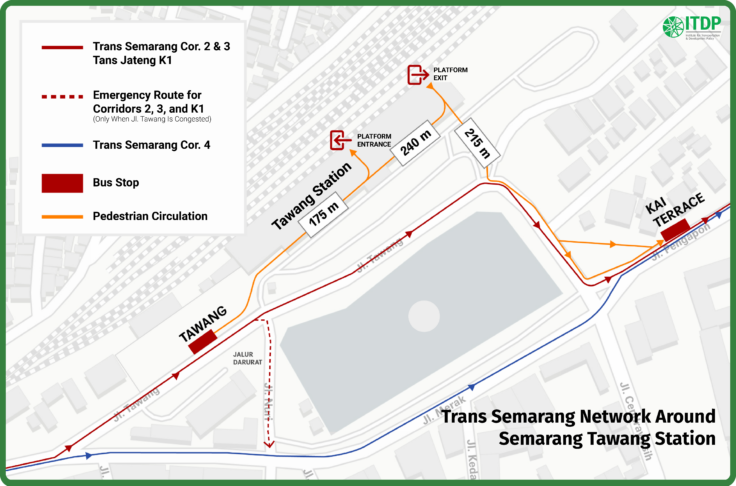
Existing public transport stops around Tawang Station are not always conveniently located, while pedestrian infrastructure, speed management, and inclusive access remain limited in the Old Town area. ITDP’s research highlights the need to connect the station with surrounding neighborhoods, public services, activity centers, and tourist destinations through walking, cycling, public transport, and micromobility. This means that integration must extend beyond the station itself. Tawang Station could become an area-wide mobility hub, but that role will depend on strong first- and last-mile connections and better integration with the existing neighborhood network.
Housing Must Be Part of the Equation
Improving accessibility is not only about helping people reach a neighborhood. It is also about ensuring that they can remain there and benefit from the improvements. Semarang already has several tools to support this objective, including policies for vertical housing, affordable housing programs, informal settlement upgrading, and self-help housing improvements. Yet current plans for the Tawang TOD area do not include concrete measures to address housing conditions within the wider area. This is a critical gap. Improved transport access can increase an area’s attractiveness and land values, potentially displacing lower-income residents.
Jakarta’s experience shows why mobility improvements need to be paired with housing protections and strategies to prevent gentrification. In established neighborhoods such as those around Tawang Station, TOD can instead build on what already exists. Upgrading settlements, protecting affordable housing, reviewing heritage regulations, and better using existing tools for vertical development and land consolidation can support neighborhood improvement without displacing communities.
Jakarta and Semarang show that Indonesia has no single physical model for TOD. Jakarta has developed a relatively advanced regulatory and institutional framework, but its experience also shows that implementation can fall short when it overlooks housing affordability and neighborhood connectivity. Semarang presents a different opportunity. Rather than reproducing Jakarta’s development model, the city can apply the same fundamental TOD principles to an established, heritage-rich urban area. Cities need to standardize TOD principles, not just the physical form.
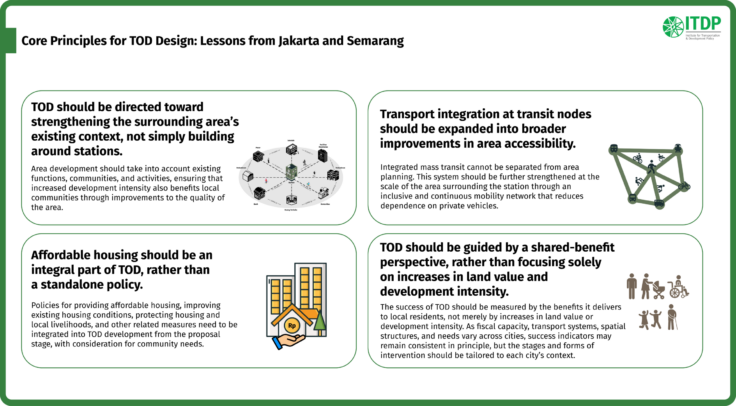
Those principles should ensure that public transport, housing, walking, cycling, public space, and urban development work together, while allowing each city to decide how to achieve those objectives. Jakarta can provide an important reference for Indonesia’s emerging TOD agenda, but it should not be treated as a blueprint. Semarang, in turn, demonstrates how TOD principles can be adapted to existing neighborhoods with distinct cultural, physical, and housing characteristics. Successful TOD is not defined by how many buildings surround a station. It is defined by whether people can reach the places they need safely and affordably, access reliable public transport, and remain part of the neighborhood as it develops.
By putting these principles at the center of planning, Indonesian cities can create TOD approaches that are not only better connected but also more inclusive, resilient, and responsive to the communities.