
October 28, 2025
Ahead of COP30, the Spotlight is on More Nature-Based Solutions for Cities

It is no secret that cities are responsible for a large share of global greenhouse gas (GHG) emissions, and urban transport is one of the key contributors to this.
Learn more about ITDP Brazil’s related work on urban mobility here.
The design and functioning of a city’s mobility system have a significant impact on both emissions and vulnerability to climate-related risks, such as extreme heat, flooding, and weather-related disasters. For example, sprawling and car-oriented cities tend to have more asphalt and concrete surfaces that exacerbate ‘heat island’ effects in high temperatures, while also being more vulnerable to flooding because these surfaces are less absorbent to rain.
A vital solution to these challenges would be to rapidly orient more urban infrastructure towards natural blue-green (greenery and water-based) solutions, which will be more resilient and adaptable to climate volatility. Beyond its environmental impacts, nature-oriented cities can also have many positive effects on public health, economic growth, social engagement, and, of course, mobility. Blue-green infrastructure often complements pedestrian and cycling networks as well as public transport corridors, while de-emphasizing the need for emissions-heavy car trips.
While many people point to European cities as examples of where climate resilience and nature-based solutions are leading the way, one country in the Global South is also quickly building a reputation as a leader in this area. Brazil is recognized as the most biologically diverse country in the world, with rich geographies spread across distinct biomes, most notably within the Amazon rainforest. As the consequences of urban sprawl become increasingly apparent, cities in Brazil are embracing blue-green solutions to address challenges such as rising emissions, traffic congestion, and extreme heat.
This year, the port city of Belém, known as the gateway to the Amazon, is preparing to host COP30, bringing a global spotlight to the potential for innovation and integration with natural environments. Two-thirds of Belém’s residents live across 39 islands, intricately linking its river waterways and urban transport systems. This is a crucial moment to call for more international guidance and commitments to prioritizing natural, sustainable environments within policy and planning. We can start by drawing inspiration from progress already underway in Brazil.

The Urgency of Resilience in Brazil
Recent extreme climate events in the country (e.g., severe floods and record heatwaves) demonstrate how climate change is already exacerbating urban hazards and inequities. Undoubtedly, these events have been intensified by emissions-driven climate change, which means that planning and transport networks that continue to ignore flooding and heat impacts will leave public infrastructure increasingly fragile and exposed to destruction.
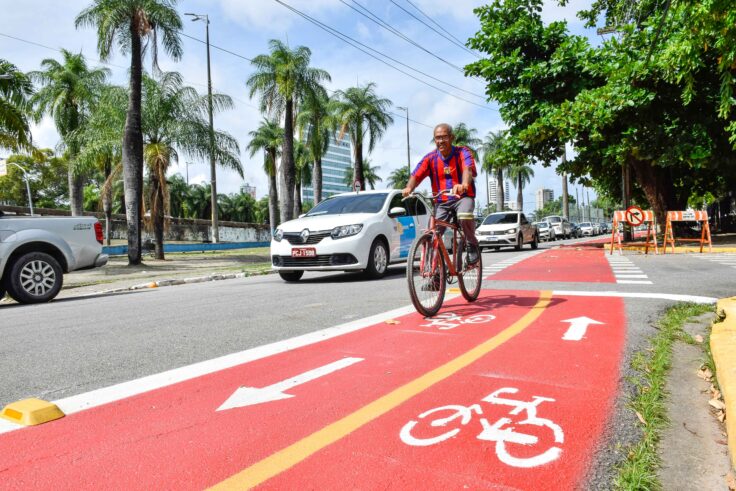
Brazilian cities are facing a dual challenge: transport systems that still rely heavily on fossil fuels and rapid growth that increases exposure to flooding, heatwaves, and other shocks. Improving urban mobility while strengthening climate resilience presents a unique opportunity for nature-positive strategies and technologies that can reduce emissions, restore ecosystems, and protect people and wildlife. Green solutions are closely linked to better public transport infrastructure, electric bus fleets, and enhancements to walking and cycling corridors, which reduce emissions per passenger and improve access to jobs and services.
The evidence for nature-based, climate-resilient infrastructure in Brazil has been mounting over the years. In 2018, ITDP Brazil released Adaptação para a Mudança Climática (Adaptation to Climate Change), a study conducted in partnership with the Brazilian Ministry of Cities and INPE (Brazil’s National Institute for Space Research). This study examines the vulnerability of Brazil’s transport systems to ongoing and future climate events. It identifies trends already underway in Brazil, including increases in precipitation, higher average temperatures, and more frequent extreme weather. The report also provided an analysis of how these changes will impact mobility systems across various aspects, including infrastructure, operations, access, and user risk.
It concludes that there is an urgent need to mitigate adverse impacts on urban mobility through better infrastructure and engineering planning, as well as policy and institutional changes. Brazil needs to prepare its transport infrastructure and urban systems for the climate impacts already occurring, not just future changes. Adaptation should include anticipatory planning, integration of natural environments, and a focus beyond just on technical fixes. Instead, cities need a simultaneous spotlight on improving governance, institutional capacity, and resilient design.
Models for Integrating Nature and Mobility
Examples of progress are underway in some major Brazilian cities. The coastal city of Recife, for instance, is undertaking an environmental recovery project for a 15-kilometer-long ecological riverbank corridor (Capibaribe). The project involves converting parts of it into linear parks, improving the riverbank environment, making the corridor more accessible for walking and cycling, and restoring ecological function. These infrastructure and space improvements are poised to benefit over 40 neighborhoods, serving a population of more than 520,000 residents. They not only improve access to green spaces and active mobility networks but also help to reduce the impacts of air pollution and aid in flood adaptation.
The eastern port city of Salvador, Brazil, has established 39 conservation areas spanning 19 square kilometers to help restore the region’s natural Atlantic Forest biome and strengthen resilience. Ecological corridors connect many of the areas, and further efforts have been directed at providing more green infrastructure elements and accessible space for residents, particularly in the city’s low-income communities. These efforts aim to increase the strength of the Forest biome to climate events and restore habitats and biodiversity throughout urban parks and waterways. The rehabilitation program has planted an estimated 30,000 trees in and around the city, with many serving as greening measures along main thoroughfares that connect with the city’s bus rapid transit routes and hubs.
Watch this webinar, in Portuguese, from ITDP Brazil for more context on nature-based solutions and urban mobility.
The city of Sobral is a medium-sized city in the semi-arid area of northeastern Brazil. During the development of the city’s Urban Mobility Plan, the need to promote more walking and cycling was identified. Still, the city’s scorching daytime heat was considered a significant challenge. This led to the creation of an urban reforestation plan and, subsequently, a Green Corridors proposal that integrates walking and cycling networks with squares and parks. In total, more than 2,500 trees were planted, mainly native species, along 15 kilometers of corridors that cross 11 neighborhoods and pass through squares and parks.
Two of the urban parks connected by the cycling network are river parks that received nature-based solutions to increase rainwater retention capacity, reducing flood risks. They also feature natural wastewater treatment systems, known as filter gardens, composed of aquatic plants and substrates, which help reduce the amount of waste discharged into rivers. It is estimated that these initiatives stand to benefit 85,000 people across Sobral and its neighboring municipalities.

A Greener Future is Possible
These examples are just a few that highlight the potential for Brazilian cities to achieve positive environmental and social impacts with nature-forward strategies. The road ahead requires governments to scale more pilots and embed more nature-based concepts into mobility plans in the long term to ensure improved access and integration with green-blue infrastructure. Novel financing mechanisms, such as municipal bonds, adaptation funds, and blended public-private models, will be crucial in bridging the investment gaps for implementing these solutions.
At the same time, policies must prioritize these interventions in the neighborhoods most vulnerable to floods and heat, helping to close equity gaps that have long defined urban development in Brazil. The federal government’s New Growth Acceleration Program (NovoPAC), which commits to investing billions of R$ into resilient, modern urban transport infrastructure, offers promising momentum. ITDP Brazil is continuing to support the program related to zero-emission transport, particularly given the potential for future alignments of funding and policy at scale, with nature-based solutions at the center.
Ultimately, cities can no longer be built solely on concrete and asphalt. Public infrastructure must be reimagined as living systems that integrate natural processes rather than override them. The promise of nature-focused mobility lies in its ability to deliver co-benefits: cooler streets, reduced flood losses, cleaner air, more biodiversity, and healthier populations. For Brazil and other nations, these strategies are not optional, but essential investments in the future. We must create mobility systems that are not only more resilient in the face of climate change, but also significantly better places to live.
As COP30 convenes the global climate stakeholders and policymakers at the edge of the Amazon, this is the moment to spotlight a more nature-positive path for our collective well-being.