
September 09, 2025
This City in India Offers Crucial Lessons for Safe, Accessible Streets
The city of Nagpur is one of the fastest-growing urban centers in central India.
Read the original version of this article from ITDP India for more details on the assessment.
With a population of nearly 2.9 million and rising, the city is facing challenges with the rapid expansion of its road network and increases in vehicle ownership. At the same time, Nagpur has positioned itself as an early adopter of sustainable mobility infrastructure, including electric buses, metro rail, and recent street redesigns that seek to prioritize walking and cycling. Yet like many Indian cities, it faces a pressing challenge: how to ensure that growth does not come at the expense of walkability, safety, and access for people who rely on non-motorized transport.
Walking and cycling remain critical for Nagpur’s residents. A large share of short daily trips is still made on foot or by cycle. Public transport users, too, depend heavily on safe walking and cycling routes for the first and last mile of their journeys. Against this backdrop, the Nagpur Municipal Corporation (NMC), with technical support from ITDP India, conducted a 2025 Urban Street Assessment Report.
Covering seven major streets across a 10-kilometer stretch, the study combined infrastructure analysis, observation surveys, and feedback from over 300 citizens to evaluate the city’s progress. Its findings shed light on both strong achievements and persistent gaps, offering a roadmap for how Nagpur can transform its streets to better serve all users. In particular, one road stood out in the assessment as a model for the rest of the city to follow.
Progress in Street Design, But Gaps Persist
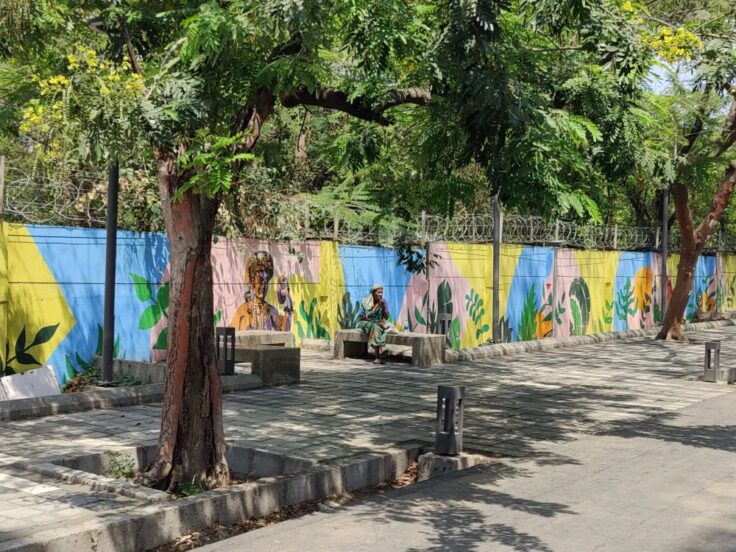
Among all the streets surveyed, Wardha Road A—a 1.3-kilometer section of street—stood out as a testament to people-friendly design. It scored 24.75 out of 30 in the assessment, the highest in the city, and is recognized as one of the most walkable and cycle-friendly streets in Nagpur. The reasons were clear: continuous and usable footpaths on both sides, cycle tracks with more than 90% connectivity, and almost universal use of these facilities by pedestrians. Public perception surveys were equally positive, with 87% of respondents reporting improvements in walkability and cyclability and over 80% feeling safe while crossing. The street also offered comfort features such as shaded trees, seating, pedestrian lighting, and wide, accessible paths.
The assessment also revealed stark contrasts with infrastructure just beyond this stretch. Wardha Road B, though redesigned alongside Wardha Road A, scored significantly lower at 18.75 and suffered from three times as many obstructions. Ring Road, which had the highest cyclist volumes at 160 per hour, lacked a cycle track entirely and was obstructed nearly 200 times along the survey segment. Central Bazaar Road forced all pedestrians onto the carriageway due to unusable footpaths. These examples illustrate how isolated successes cannot offset larger-scale shortcomings in infrastructure. When safe and comfortable streets exist in only small pockets, walking and cycling become fragmented, inconsistent, and unattractive compared to vehicle use.
The assessment revealed these patterns through three approaches. Design surveys analyzed infrastructure features, observation studies recorded how users interacted with them and documented obstructions, and perception surveys gathered citizen views on safety and accessibility. The combined results highlighted several broader challenges: vehicle speeds were often too high, averaging more than 60 km/h on many streets; redesigned roads failed to meet expectations due to inconsistent standards; obstructions from parked vehicles, commercial spillover, and street vendors were widespread; and poor construction quality left many footpaths uneven and degraded.
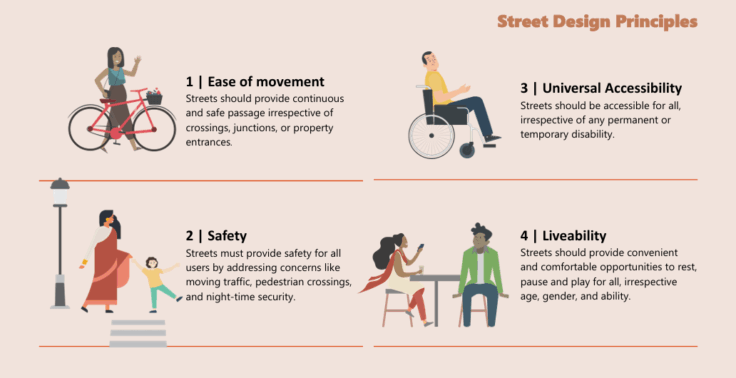
Download ITDP India’s full two-part assessment and analysis of Nagpur’s streets here.
Challenges of Safety, Quality, and Inclusion
The findings highlight how Nagpur’s streets still remain unsafe for many pedestrians and cyclists. More than 65% of citizens surveyed expressed concerns about children’s safety, especially, citing speeding vehicles and inadequate pedestrian crossings. This is particularly concerning given that many of the cyclists recorded during school hours were students. Without targeted interventions, children and their families are left with unsafe options for daily travel.
Another challenge lies in the inconsistent outcomes of redesigned streets. While redesign projects are often hailed as best practice, Nagpur’s experience shows that without comprehensive standards and strict oversight, even recently completed streets can fail to provide safe or usable infrastructure. For example, Amravati Road, redesigned in 2023, scored just 12.25 out of 30, with fewer than half of respondents reporting improvements in walkability or cyclability. This uneven performance undermines public trust and limits the development of a reliable non-motorized transport network.
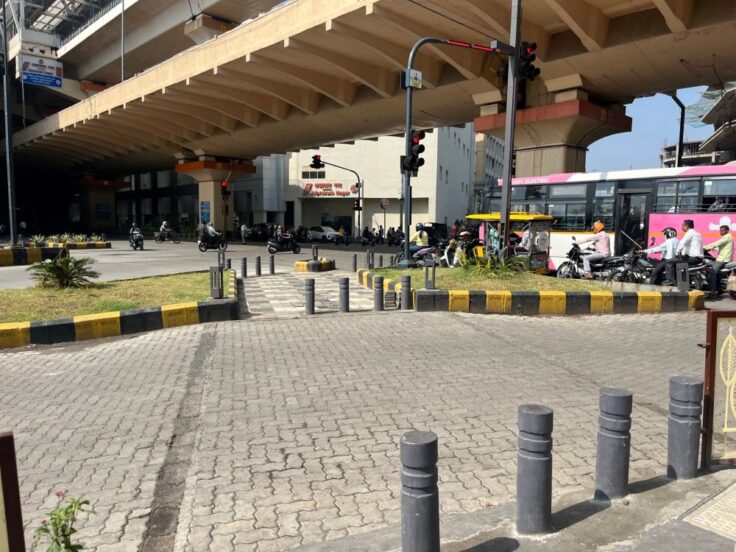
Obstructions and poor quality further constrain accessibility. The study recorded over 1,900 obstructions across just the 10 kilometers surveyed, with erratically parked vehicles identified as the most common and frustrating barrier. Even where footpaths exist, encroachment often forces pedestrians back onto the carriageway. In addition, poor material choices in designs created uneven, degraded walking surfaces that also make usage less attractive. Collectively, these issues show that Nagpur’s streets still have a long way to go, but examples like Wardha Road A also show that change is possible.
Building a More Connected and Consistent Network
To address these challenges, the report identifies several steps Nagpur can take. First, the city must adopt a network planning approach rather than focusing on individual showcase projects. By developing a connected system of safe streets across entire neighborhoods, citizens can complete their journeys without facing sudden breaks in infrastructure. This approach allows the municipality to prioritize projects in phases, allocate budgets effectively, and monitor outcomes consistently.
Second, Nagpur should prioritize safe school zones. Given the high numbers of children walking and cycling to school, redesigning these areas with slower traffic, protected crossings, dedicated parking and drop-off zones, and supportive street furniture would deliver immediate benefits.
Third, adopting Urban Street Design Guidelines (example for the city of Pune) would ensure consistency across agencies such as the Nagpur Improvement Trust, Public Works Department, and NMC itself. Standardized materials, processes, and design features would improve construction quality, simplify procurement, and reduce the risk of uneven results.
Finally, supportive policies are needed to embed these priorities into long-term planning. A Nagpur Healthy Streets Policy could enshrine the city’s commitment to walking and cycling, while a comprehensive parking policy would help reduce encroachment on footpaths and free up space for pedestrians. Together, these measures would create a stronger framework for sustainable street transformation.
Moving forward, the challenge is not to create just a few exemplary stretches of road, but to transform the entire street network in Nagpur into a connected, inclusive, and resilient system. The importance of this effort extends beyond walking and cycling alone and offers crucial lessons for all cities and policymakers seeking sustainable, inclusive growth. Walkable streets are the foundation of effective and quality public transport networks. Most trips on public transport begin and end with a walk or cycle ride. If those first and last mile connections are unsafe or inconvenient, people are less likely to use public transport, opting instead for costly and harmful private vehicles. And that is a surge today’s cities cannot afford.
By being more strategic and consistent with street design, cities like Nagpur can strengthen their investments in public transport, improve health and air quality, and create more livable environments.