
August 26, 2025
Why More National Action is Needed for Indonesia’s E-Bus Transition
Six years after Indonesia set a national commitment to promote Battery Electric Vehicles (BEVs), cities across the country have begun transitioning their public buses to electric ones. Jakarta led the way in 2022, followed by cities such as Medan, Surabaya, and Pekanbaru.
Read the original version of this article at ITDP Indonesia.
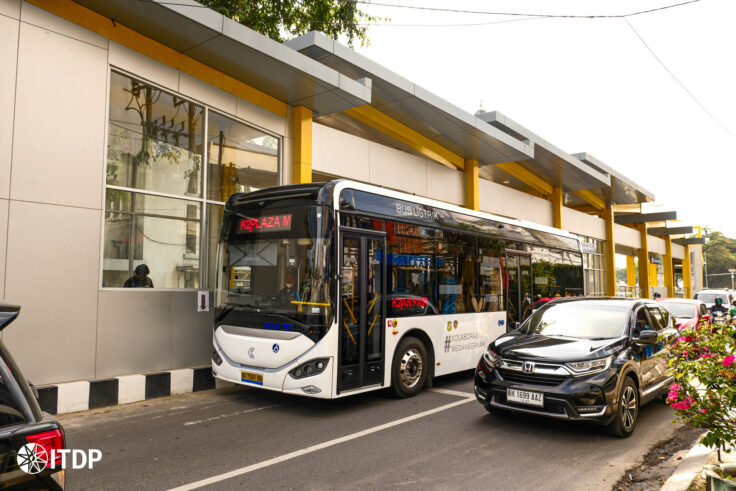
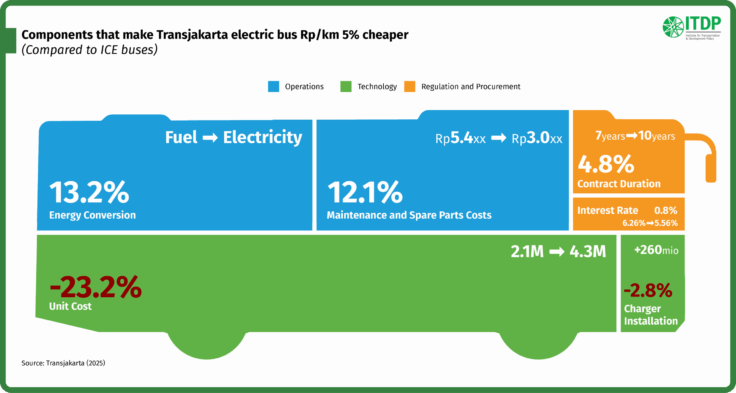
Progress has been steady, but scaling up remains a steep climb. With a strong fiscal capacity and a dedicated public transport authority, Jakarta has led the nation’s e-bus transition, being the largest and most populous metropolitan region. Trials began in 2019, and by 2022, the city committed to 100% electrification of its public transport vehicles by 2030. By 2024, operating costs per kilometre for Transjakarta’s electric buses were already 5% lower than those of diesel buses, enabling the government to serve more passengers with the same number of subsidies.
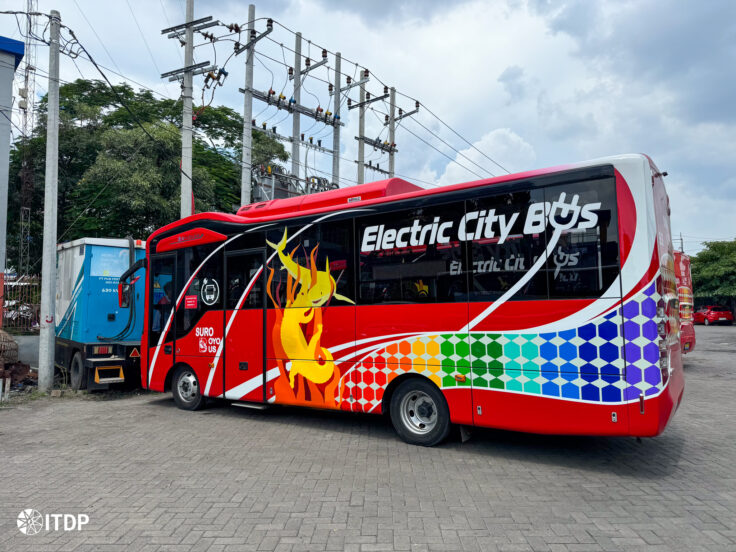
Other cities have also begun making headway in recent years, beyond Jakarta. Since 2024, the city of Medan has implemented 60 electric BRT buses, while Surabaya has implemented twelve buses. Yogyakarta and Semarang have each launched small pilots. Pekanbaru made history in 2025 by becoming the first city to launch a permanent electric feeder bus service.
Although there have been these types of targeted electrifications efforts, most notably through Transjakarta’s rollout in Jakarta, most of Indonesia is still struggling with implementation at -scale. Fiscal constraints, institutional instability amongst transport authorities and operators, and inconsistent national-level targets continue to hinder the broader adoption of e-buses. To fully harness the social, economic, and environmental benefits of e-buses, Indonesian policymakers must prioritize solutions to these issues.
Lessons from Cities
A recent study by ITDP Indonesia, Reform Strategy and Roadmap for Public Transport Electrification, highlights key takeaways from several Indonesian cities undergoing e-bus transitions, such as Surabaya, Surakarta, and Pekanbaru. The study offers several insights into facilitating a more efficient, strategic fleet transition, including:
- The need for gradual fleet expansion to improve route coverage and service quality by meeting headway standards as outlined in the Minimum Service Standards;
- The need to explore contract models that reduce fiscal burdens on local governments while maintaining, or even improving, service quality, tailored to each city’s specific characteristics; and
- The importance of inclusive infrastructure strategies that enhance accessibility for users and help maximize the impact of electrification.
Taking city-specific contexts into account, ITDP Indonesia also found that bus electrification roadmaps should begin with public minibus services (feeder services) due to their lower cost requirements and potential to expand public transport coverage. The city of Pekanbaru, for example, officially launched its electric feeder service in 2025 following ITDP’s recommendations, making it the first in the country to operate electric feeder buses beyond a trial phase.
Such feeder lines are crucial to enhancing overall public transport ridership and usage. Increasing electric bus fleets to improve public transport service quality and accessibility is certainly feasible for cities across Indonesia. Although the upfront investment in the transition may be high, the reduced operational and maintenance costs of e-buses are much lower than those of conventional fuel buses in the long term.
The Challenge of Scale
Despite the momentum, the adoption of e-buses remains modest. ITDP’s additional studies have also shown that cities require stronger national and local guidance and support to electrify their public transport effectively. Not only guidance on technology selection, such as bus specifications or charging strategy frameworks, but also on assessing city readiness, choosing appropriate contract models, and developing business models beyond the trial phase.
While a growing number of e-bus models for different contexts are now available on the market, including locally produced buses, a lack of apparent demand and policy support has led manufacturers to be cautious of production. Most deployments also remain at small-scale trial stages despite the growing number of options. Mass production has yet to take off, primarily due to a lack of demand certainty, especially from the public transport sector, which continues to deter private sector players from taking further steps.
Furthermore, public transport electrification cannot focus solely on government-operated services. Municipal transport and other semi-formal services—often run by cooperatives or individuals—remain the backbone of urban mobility in many cities. Without including this segment, achieving significant emissions reductions from the transport sector will be difficult. Among the e-bus-related challenges faced by Indonesian cities, one element stands out as most critical: the lack of a strong, legally-binding national commitment.
It is true that the national government has included bus electrification in several strategic documents, such as the National General Energy Plan, which sets a target of 10% of urban public transport to be powered by electric buses by 2025. The Ministry of Transportation has also set targets of 90% electrification for mass urban public transport by 2030; 100% by 2040; and full electrification of public minibus services—typically used for feeder services—by 2045.
However, on-the-ground realities show that these targets are almost impossible to achieve due to the lack of a clear regulatory framework. As of today, only 376 electric buses are operating in five cities across Indonesia. Without clearer and more strategic national guidance, Indonesia risks falling significantly behind on its national climate goals of which urban transport is crucial.
Electric buses for urban public transport are not explicitly included in the country’s emission mitigation strategies for the transport sector, including in the country’s Nationally Determined Contributions. This omission is one that needs to be addressed, and the inclusion of e-buses can be a vital step forward. ITDP research has shown that the 100% electrification of public transport in even 11 Indonesian cities can reduce GHG emissions to 24% by 2030, equivalent to approximately 900,000 tonnes CO₂e emissions.
To reach the country’s climate targets, policymakers and public and private stakeholders must focus on collaboration and investment to help public transport systems electrify at scale. A stronger vision from Indonesia’s national government can help lay a better foundation for electrification by providing clear and consistent targets and more incentives for operators, manufacturers, and local agencies.
Only with top-down government commitments can e-buses become a more widely adopted and replicable mobility solution for the country that serves all Indonesians.